
Big spending, little future: Germany is rearming differently from Poland and the UK
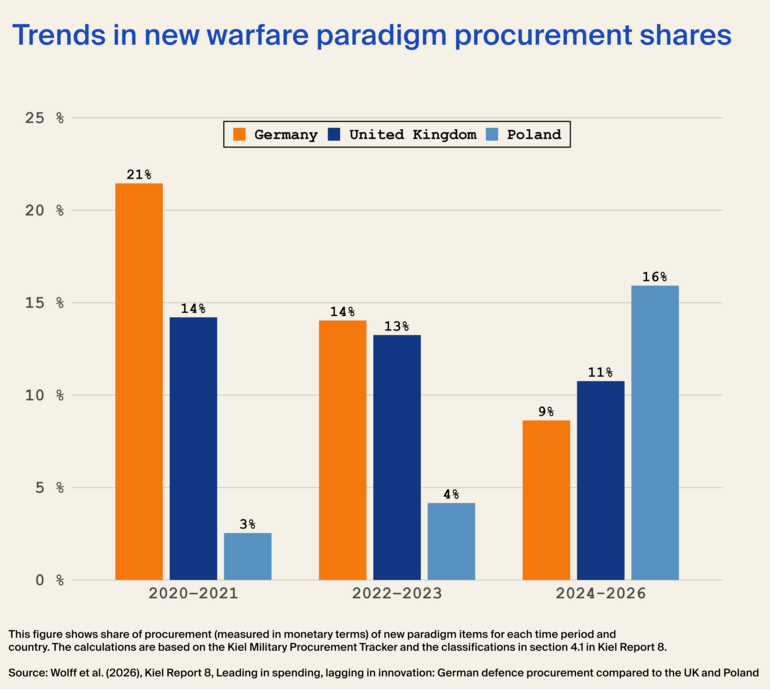
Germany ordered military equipment worth around €85 billion in 2025—more than the United Kingdom (€25 billion) and Poland (€21 billion) combined. At the same time, however, the share of modern technologies in German procurement has declined significantly: whereas before the war in Ukraine, 21 percent of orders still went to innovative systems, today the figure is only 9 percent. Poland is moving in the opposite direction, increasing the share of modern technologies from 3 percent (2020/2021) to 16 percent today. The United Kingdom stands in between at 11 percent. These findings come from a new Kiel Report on the development of European defence investments.
The report is based on the third version of the Kiel Military Procurement Tracker and analyses procurement policy in Germany, the United Kingdom, and Poland between January 2020 and January 2026. During this period, military contracts worth a total of €422 billion were awarded across the three countries. In 2025 alone, procurement volume reached €137 billion—a historic record. December 2025 was particularly striking: with more than €53 billion in orders, Germany recorded the strongest single month in its history.
Despite the surge, German investments in disruptive technologies—including (semi-) autonomous platforms, drones, AI-based command systems, and networked air defence—have remained largely constant in absolute terms since 2020. Their share of overall procurement has even declined. In the United Kingdom, spending on new-paradigm systems has risen in absolute terms, but the composition of the procurement portfolio has changed very little. Only Poland has noticeably shifted its procurement in favour of the technologies that have proven especially relevant in the war in Ukraine.
Political leadership makes the difference
“Germany is procuring more of the same—but not the right things,” says Guntram Wolff, lead author of the report and Fellow at the Kiel Institute. “So far, the Zeitenwende has been primarily a quantitative, not a qualitative, shock. While Ukraine is reporting successes with autonomous systems and cost-efficient drones are already visibly transforming warfare, German strategy postpones the goal of technological superiority to the years 2035–2039—well beyond NATO’s stated threat horizon of 2029.”
Wolff points to the lack of political backing from the highest level: “Germany’s strategy is supported only by the defence minister, not by the chancellor. In the United Kingdom and Poland, the prime ministers are personally driving the modernisation agenda. This difference is directly reflected in procurement decisions.”
Fragmented market, unclear delivery outlook
The report also shows a pronounced home bias: cross-border procurement within Europe remains marginal in all three countries. Delivery times for ordered equipment typically range between two and four years. Particularly concerning: for around 70 percent of Germany’s most recent orders, no concrete delivery date has been specified—a trend not observed in the United Kingdom or Poland.
Political consequences
The authors call for a realignment of Germany’s procurement strategy: priority for autonomous systems, AI-supported command structures, and low-cost, scalable weapons systems, accompanied by corresponding adjustments in military doctrine and training. “If Germany continues on its current course,” Wolff warns, “it risks building Europe’s largest conventional army—ready for yesterday’s war, but not for tomorrow’s.”