

European defense autonomy is technologically feasible, fiscally viable, and politically achievable
The Sparta 2.0 paper identifies ten strategic capability gaps, prioritizes key programs, and puts the cost of European sovereignty in the security and defense sector at approximately €50 billion per year
- Dr. Jeannette zu Fürstenberg, Prof. Dr. Moritz Schularick, Nico Lange, René Obermann, and Dr. Thomas Enders identify ten key areas, ranging from military cloud computing to air defense, command and control systems, communications capabilities, and satellite reconnaissance
- The cost of these key defense autonomy programs is estimated at €150-200 billion through 2030, and at approximately €500 billion over the next decade
- Sparta 2.0 paper calls for an end to fragmentation in the defense sector and advocates for implementation through resilient lead coalitions rather than a European superstructure
- With political will and European cooperation, a sovereign deterrence and defense capability could be achieved in the short and medium term
- Defense spending is an investment in Europe’s future: Every euro invested in high technology can generate up to €1.50 in economic value
Despite ranking as the second-highest defense spender in the world, Europe remains strategically dependent on the United States across the entire military chain of operations. Increased funding has not yet translated into increased capabilities and autonomy.
The Sparta 2.0 paper published today and signed by Dr. Jeannette zu Fürstenberg, Prof. Dr. Moritz Schularick, Nico Lange, René Obermann and Dr. Thomas Enders, demonstrates that Europe can close its strategic capability gaps over the next decade at an cost of approximately €500 billion. This amounts to roughly one-third of the planned annual increase in European defense budgets of €200 billion, 10 percent of the planned defense spending of European NATO partners by the end of the decade, or 0.25 percent of European GDP (including the UK and Norway). Independent European agency and European conventional deterrence and defense are not a matter of cost or technological capability; they are a matter of political prioritization and leadership, industrial coordination, and the willingness to leave behind the inefficient fragmentation of European defense. Additionally, new approaches to procurement and capacity expansion are required.
Dr. Thomas Enders: “The new military strategy for the German Bundeswehr sets the right priorities: information superiority, multi-domain operations, and long-range strike capabilities. Sparta 2.0 provides the industrial and technological framework to achieve these goals and demonstrates that a high degree of European independence can be achieved within a few years, at a cost that can be financed through the planned budget increases. The message is: the bottleneck is neither money nor technology. It is the political will to act as Europeans, to make decisions, and then to implement them as quickly and pragmatically as possible. Ukraine shows us that this does not take decades.”
René Obermann: “Those who cannot organize their own defense cannot take responsibility for it either. European sovereignty is not merely a foreign policy option; it is the fundamental prerequisite for strategic credibility and the ability to act. Our allies expect of Europe exactly what we owe ourselves: the ability to act independently.”
Ten key programs to close strategic capability gaps
Significant progress toward sovereignty can be achieved within 3-5 years, and a high degree of autonomy can be reached in most areas within 5-10 years — provided these are pursued as a political priority through a concerted European effort. The key programs defined here are designed to achieve initial operational capability by 2029 and are synchronized with Bundeswehr planning.
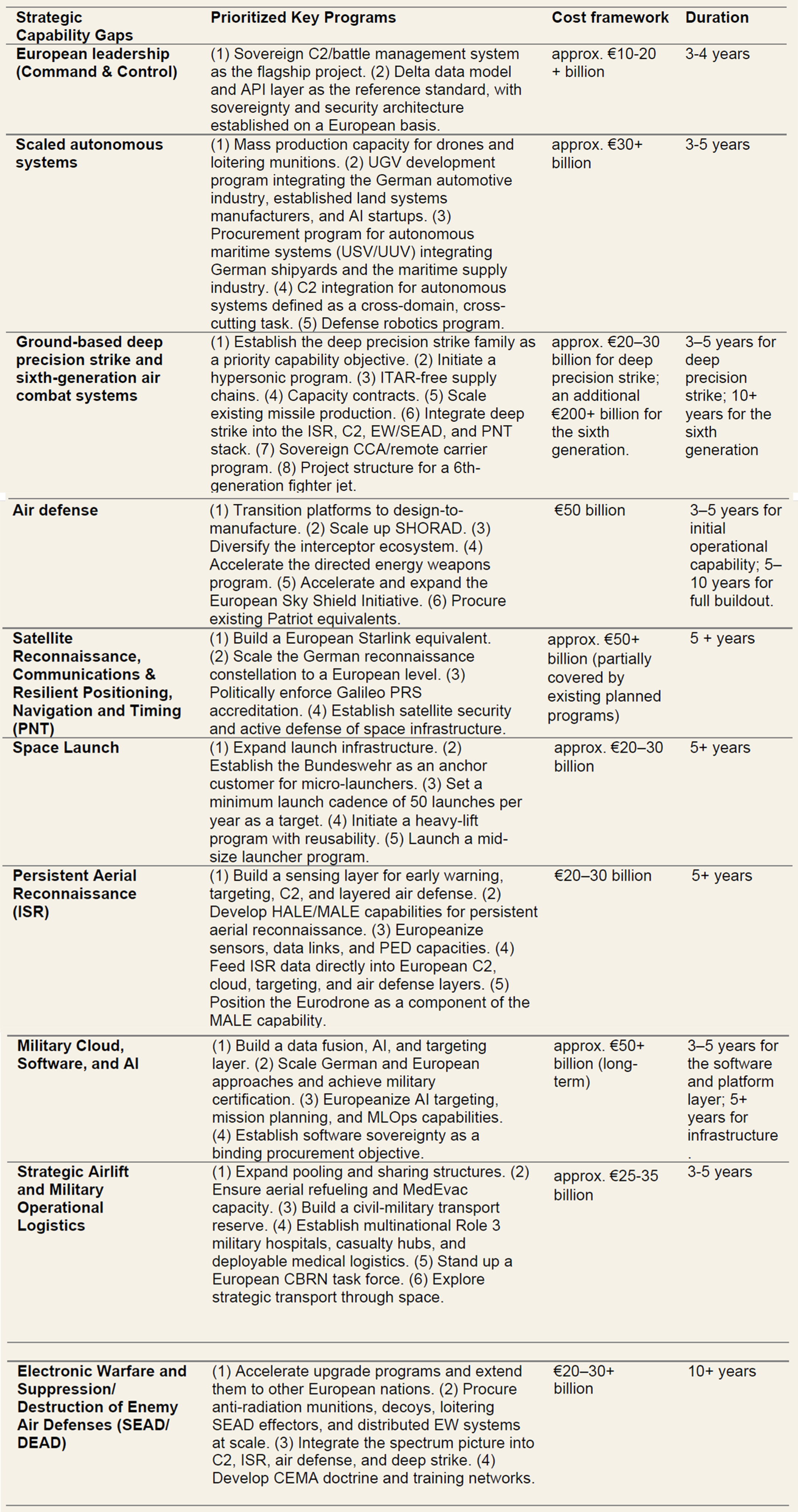
Implementation through European cooperation
The paper advocates implementation through resilient lead coalitions rather than the creation of a new European superstructure. Germany, France, Poland, and the United Kingdom should coordinate major strategic programs, conventional reach, and dialogue on nuclear policy. Northern Europe, the Baltic states, and the Netherlands should form the core of a coalition for maritime autonomy, the protection of the Baltic and North Sea as well as electronic warfare. Germany could take a leading role with partners in the area of air defense and drone defense. At the EU level, joint funding and civil-military infrastructure should be secured.
Europe has the technological and industrial foundations
European companies are technological leaders in many fields; they develop and build tactical command software, military cloud infrastructure, and autonomous systems. To translate this expertise into military capabilities, political will, coordinated resource mobilization, and the institutional capacity for action must converge. Ukraine demonstrates how this can be done: The Delta tactical battlefield management system was developed within 18 months and is now the most capable of its kind outside the United States.
Dr. Jeannette zu Fürstenberg: “We have the technological and industrial foundation in Europe to become capable of deterrence and defense. We are also currently seeing a generation of founders in Europe who have committed themselves to the cause of European sovereignty and are building technologically leading companies. What we must now find is the courage to trust them and direct capital toward strategic independence. The critical bottleneck is not money or technology; it is the institutional capacity for implementation, industrial coordination, and political leadership."
Defense spending is an investment in Europe’s future
Europe concentrates 70 percent of its defense spending on the ten largest defense contractors. In the United States, this share is less than 30 percent. At the same time, Europe operates 14 different types of tanks, 15 different fighter jets, and fragmented command systems. This fragmentation erodes economies of scale: according to the SWP, Europe achieves 30 to 40 percent fewer capabilities per euro invested than a consolidated state. Additional funds should therefore flow into additional production facilities, new suppliers, and technology sectors.
This is particularly relevant given that investments in high-tech programs also generate outsized economic value and industrial spillover effects. The investment ranges in this paper account for macroeconomic multiplier effects ranging from 0.6 to 1.5x. This means that every euro invested may generate up to €1.50 in added economic value.
Prof. Dr. Moritz Schularick: “Defense investments in high technology are not mere expenditures; they are technology policy with a security dividend. Every euro invested in software, AI, and space exploration can generate an economic multiplier of up to 1.5. Europe can afford these investments – what it cannot afford is to forgo them. Europe must ask itself whether the money should once again flow into legacy systems and abroad, or into the technology sectors that can shape Europe’s industrial base for the coming decades.”
A Paradigm Shift in Procurement Is Necessary
To deploy capital effectively, efficiently, and in a way that serves industrial policy objectives, a paradigm shift in procurement is necessary. The paper outlines five courses of action:
- “Show before you buy”: Prototype competitions instead of hundreds of pages of specifications that end up with non-competitive products years later.
- Outcome-based rewards instead of input specifications: Describe problems, don’t prescribe solutions; outcome-based contracts with clear KPIs.
- Capacity contracts instead of volume-based procurement.
- A European Fast-Track for sovereignty projects.
- Ecosystem diversification—moving away from gold-standard solutions toward low barriers to entry for new providers, with the systematic inclusion of dual-use technologies
Nico Lange: “The question is not whether we invest, but how we direct those investments to strengthen Europe’s ability to act, anchor technological leadership, and create industrial value in Europe. If we use these substantial funds strategically for sovereignty, technology, and speed, we will become capable of defending ourselves and acting as a deterrent.”
The paper is the product of an expert process bringing together voices from academia, industry, investment, and the military. The cost estimates underlying this paper are based on publicly available comparative data as well as expert assessments from industry and academia. Given the novelty of many capabilities and the absence of reference projects at the European level, deviations of ±20–30% per capability category should be expected. This does not alter the core argument: The total costs for Europe’s defense autonomy fall within a fiscally manageable range for Europe.