Rental dynamics slow down—Berlin below previous year’s level
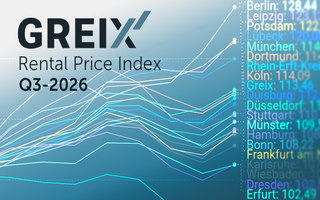
In the first quarter of 2026, asking rents in German cities rose only moderately. On average, nominal rents increased by 0.5 percent compared to the previous quarter and by 2.9 percent compared to the same quarter last year. This is the lowest nominal annual growth rate since the fourth quarter of 2021. When adjusted for inflation, rents decreased slightly by 0.1 percent compared to the previous quarter.
These findings are based on the latest update of the GREIX Rental Price Index published by the Kiel Institute for the World Economy. The index analyzes asking rents for apartments in 37 German cities and regions using data from the Value market database.
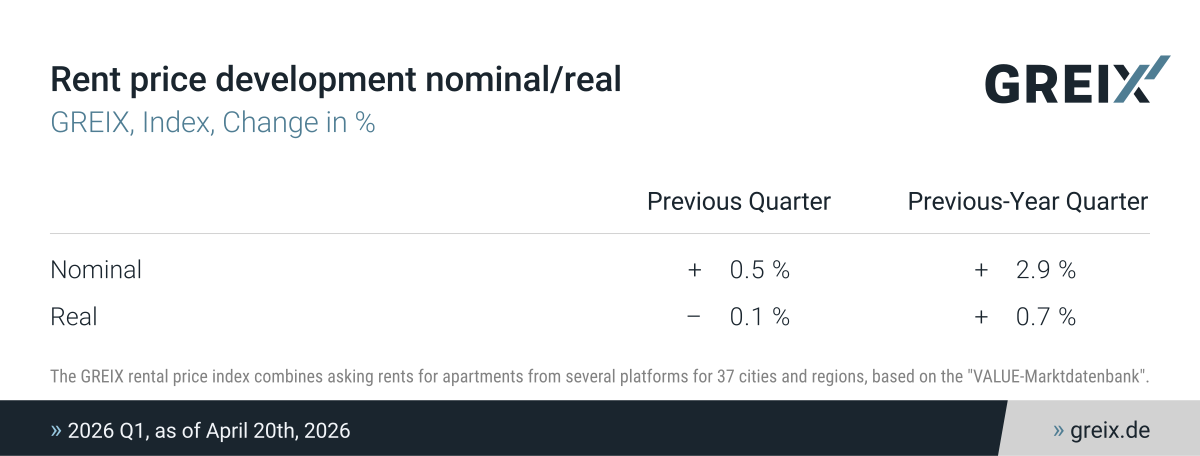
"The quarterly picture is clear: at 2.9 percent year-over-year, nominal growth is at its lowest level in over four years. In real terms, rental prices have fallen slightly compared to the previous quarter. Looking further back, we see that compared to the inflation-adjusted peak in 2020, real asking rents today are only 2.8 percent higher. This shows that asking rents have not deviated significantly differently from the general rate of inflation. However, the market remains fragmented, with large differences between cities," says Jonas Zdrzalek, GREIX Project Lead, Kiel Institute for the World Economy.
Wide range among the eight largest cities
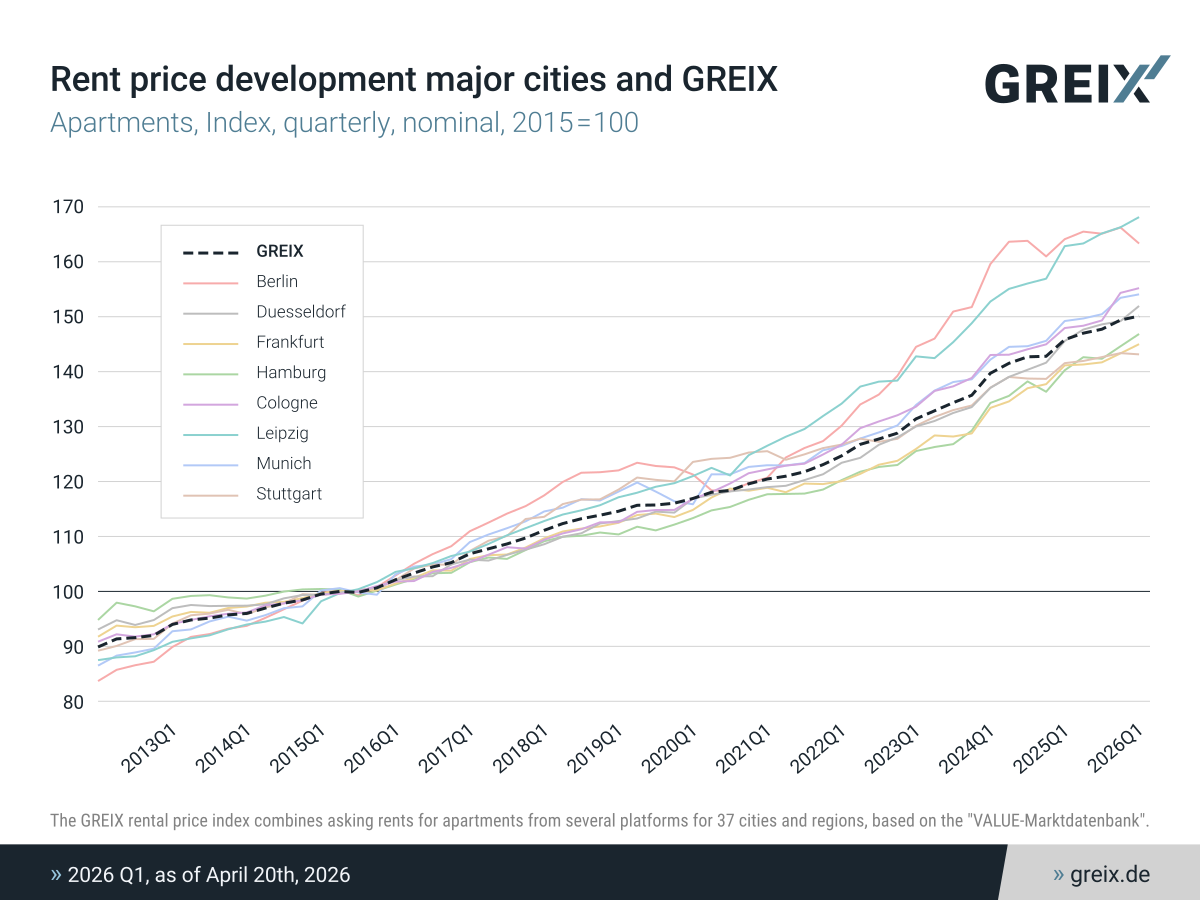
In a quarter-on-quarter comparison (Q1 2026 to Q4 2025), developments in Germany's largest cities varied. Growth rates above the national GREIX average of 0.5 percent were recorded in Düsseldorf (+1.9%), Hamburg (+1.6%), Frankfurt a.M. (+1.2%), Leipzig (+1.1%), and Cologne (+0.6%). Munich's growth rate of +0.4 percent was slightly below the national average. In contrast, Berlin (−1.8%) and Stuttgart (−0.2%) experienced declines.
Rent levels: Munich remains the undisputed leader
Current rent levels in Germany's eight largest cities continue to exhibit significant heterogeneity. Munich remains the most expensive city, with an average cold rent of EUR 23.56 per square meter. Following at a significant distance are Frankfurt am Main (€17.71/m²), Hamburg (€16.35/m²), and Stuttgart (€16.25/m²). Berlin (€15.84/m²) and Cologne (€15.67/m²) represent the upper mid-range, while Düsseldorf stands at €14.78/m². Leipzig marks the lower end of the eight largest cities at €10.41/m².
The weighted average across all 37 cities and regions (GREIX) is currently EUR 14.36 per square meter.
Considerable differences are also evident outside of the top eight cities. Augsburg (€14.86/m²) is already more expensive than Düsseldorf. Potsdam (€14.68/m²) and Münster (€14.27/m²) significantly exceed Leipzig. The least expensive cities are Chemnitz (€6.19/m²), Gelsenkirchen (€7.56/m²), and Hamm (€8.33/m²). The gap between more affordable and more expensive cities remains significant.
Regular rental listings continue to decline
In the first quarter of 2026, the number of regular listings on major platforms in the GREIX decreased by 0.6 percent from the previous quarter, continuing an ongoing trend. In 2025, there were approximately 250,000 regular listings, down from around 260,000 the previous year. The long-term decline is even more pronounced: across the entire GREIX, the number of regular listings has fallen by around 22 percent, from 285,000 in 2015. In individual cities such as Münster and Potsdam, the decline compared to 2015 is as high as 50 to 55 percent.
Conversely, the furnished long-term rental market is growing. In the eight largest German cities, for example, the average number of listings increased from approximately 7,500 in 2015 to around 23,000 in 2025. In the GREIX, this segment grew from approximately 12,000 to around 37,000 listings. Compared to 2015, this represents an increase of over 200 percent in both the top eight cities and the GREIX overall. The short-term rental segment (mostly temporary, furnished offers) has remained stable since 2018. Since then, it has increased by only 8.4 percent in the eight largest cities and 7.1 percent in the GREIX. Regular listings remain dominant at 73 percent (GREIX) and 63 percent (top eight cities), respectively, but their share is continuously decreasing.
"The raw rent figures only partially reveal that the market is undergoing a structural transformation. Since 2015, regular listings have fallen by more than a fifth, while long-term furnished offers in metropolitan areas have nearly tripled. Anyone looking for an apartment today in a major city via common platforms is increasingly encountering conditions that were still an exception ten years ago," says Jonas Zdrzalek.
Read short report now:
Methodological note
The price development of the GREIX rental price index is calculated as an index. This allows statistical methods (hedonic method) to be used to mitigate price distortions that often arise when using average price per square meter. For instance, if a high number of apartments in a prime location or in an extraordinary condition are sold, this can inflate average prices per square meter. However, such fluctuations may not reflect a general increase in real estate values. Using hedonic regression methods, specific property characteristics do not cause upward or downward distortions in the price trend.

About the GREIX Rental Price Index
What is the German Real Estate Index (GREIX)?
The German Real Estate Index (GREIX) is a publicly funded research project hosted at the Kiel Institute for the World Economy that aims to increase transparency in the German real estate market. To this end, GREIX regularly publishes updates on the development of sales prices (GREIX sales price index) as well as on the development of asking rents (GREIX rental price index). In addition to these price developments, GREIX publishes special analyses, for example on affordability or on price-determining factors such as location or energy efficiency.
What is the GREIX rental price index?
The GREIX rental price index is a rental price index for Germany based on asking rents for apartments from several platforms. It tracks rental price developments in individual cities and regions since 2012 and is based on several million listings. The dataset can be used to analyze trends in the rental market and to compare them with developments in the GREIX sales price index. Rental price indices for currently 37 cities and regions are freely available at `www.kielinstitut.de/greix-mietpreisindex`. The dataset will gradually be expanded to include additional cities.
What data and methods are used to compile the indices?
The VALUE Marktdatenbank provides the data foundation. It is based on an extensive collection of carefully prepared real estate market data from more than 100 sources. Asking rents are analyzed using state-of-the-art scientific methods and statistical techniques (hedonic regression method). The GREIX rental price index therefore represents the highest standard of scientific data quality.