

EU–Russia trade could fund Ukraine and increase pressure on the Kremlin
Four years after Russia’s full-scale invasion of Ukraine, billions of euros in trade flows continue between the European Union (EU) and Russia despite extensive sanctions. This remaining trade offers significant potential to mobilise additional funds for Ukraine and to increase economic pressure on Russia. A new Kiel Policy Brief shows that a targeted “Ukraine Support Tariff” on this residual trade could generate around EUR 11–16 billion annually under the higher short-run estimates.
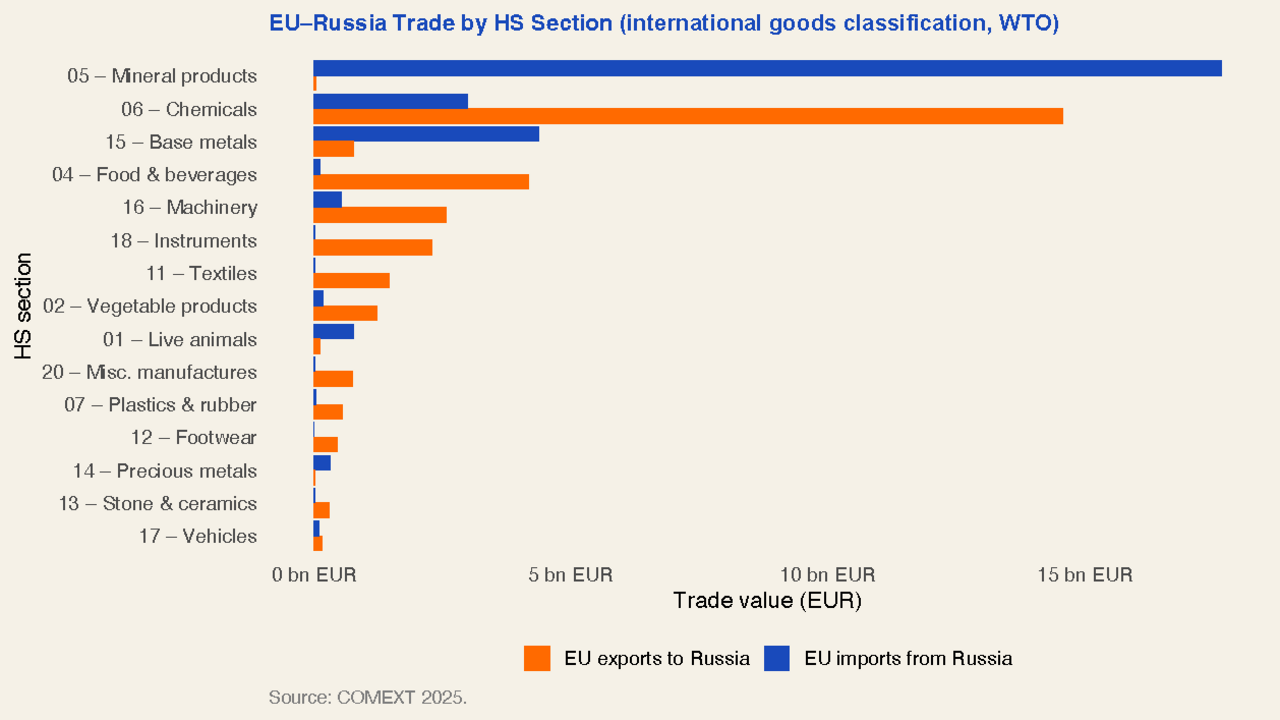
Despite twenty EU sanctions packages since 2022, bilateral trade between the EU and Russia totalled EUR 57.2 billion in 2025, including EUR 27.2 billion in EU imports from Russia and EUR 30.0 billion in EU exports to Russia. While this is substantially lower than pre-war levels, the remaining exchange still provides economic value to Russia. The analysis therefore proposes converting this residual trade into a targeted economic-policy instrument: an import tariff on EU imports from Russia combined with an export-side levy on EU exports to Russia. The import component is legally and institutionally more straightforward, while the export-side levy would require a more tailored legal approach.
“The key insight is simple: as long as trade with Russia continues, Europe should use it to support Ukraine,” says Julian Hinz, head of the Trade Policy Research Group at the Kiel Institute and co-author of the Kiel Policy Brief. “A well-calibrated tariff allows the EU to generate substantial revenues while at the same time increasing economic pressure on Russia—without imposing large costs on itself.”
Turning trade into support for Ukraine
To ensure robust results, the researchers combine two complementary approaches: one directly examines EU–Russia trade and the possible revenue potential of such a tariff. The other accounts for how firms and markets might react—through new supply chains, price changes, or trade diversion via third countries. The study concludes that tariff rates of 30 to 50 percent could generate annual revenues of around EUR 11–16 billion under the higher short-run estimates.
These revenues could provide longer-term financing for Ukraine’s military defence, reconstruction, and humanitarian needs. Even lower estimates under a longer-run decline in trade caused by the tariff would still be around or above the roughly EUR 3 billion per year currently expected from interest on frozen Russian sovereign assets. At the same time, Europe could significantly strengthen its support for Ukraine alongside existing commitments averaging roughly EUR 70 billion annually.
The analysis also shows that the macroeconomic effects of such a tariff would be highly asymmetric: Russia’s aggregate economic losses are estimated to be three to four times larger than those experienced by the EU. EU imports from Russia remain concentrated in energy products, while European exports to Russia are more diversified, including chemicals, machinery, and other industrial goods. By targeting both import and export flows, the proposed tariff broadens the revenue base and strengthens the effectiveness of the instrument. The study also finds that trade diversion to China would remain limited, while extreme tariff rates would be counterproductive because they would destroy the tax base and sharply reduce long-run revenues.
A flexible tool for policymakers
“The asymmetric cost structure makes the Ukraine Support Tariff a viable instrument for longer-term economic pressure,” says co-author Moritz Schularick, President of the Kiel Institute. “It would give policymakers a flexible instrument: tariff rates could, for example, be lowered again as part of a negotiated settlement, while the economic costs for Europe remain limited.”
Concerns that the tariff could primarily hit EU consumers, households, or firms are less compelling today. Four years into the war, firms have had enough time to reorient their supply chains. Those that continue to trade with Russia are doing so by choice, and the tariff makes the economic costs of that choice visible.
From a policy perspective, the import component of the proposal is legally and institutionally more straightforward, as it could build on existing EU trade rules. The export-side levy would require a more tailored legal design. Revenues could then be channelled through a dedicated EU mechanism to finance support for Ukraine.
“The remaining EUR 57.2 billion in EU–Russia trade shows that Europe is still leaving an important lever unused,” says Moritz Schularick. “This is a missed strategic opportunity to turn ongoing economic relations into an instrument that increases pressure on Russia, reduces Europe’s strategic vulnerabilities, and substantially strengthens support for Ukraine.”