
Research Director
Prof. Dr. Stefan Kooths
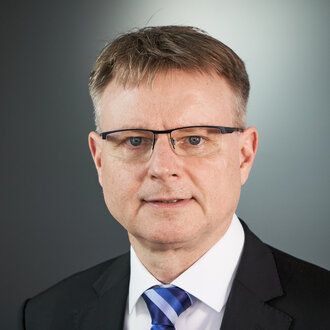
Research Director
Prof. Dr. Stefan Kooths
Stefan Kooths, born in 1969, is Director of the Business Cycles and Growth Research Group. His main fields of expertise cover macroeconomic forecasting, stabilization policies, money and banking, globalization, and constitutional economics. He is advocating a coordinationist paradigm of economics that puts systemic mismatches caused by dysfunctional social coordination mechanisms at the forefront of economic analysis and interprets macroeconomic imbalances primarily as symptoms of pervasive distortions in the economic system. Methodologically, he has a focus on computational economics (simulation software, soft computing, and knowledge-based decision support systems).
Stefan Kooths holds a Master of Science (1993) and a PhD (1998) in economics from the University of Muenster where he also worked as research associate and assistant professor at the Institute for Industrial Economics. From 2002 to 2005 he was managing director of the Muenster Institute for Computational Economics. Before joining the Kiel Institute in 2010, he held a position as Research Manager in the Macro Analysis and Forecasting Department at the German Institute for Economic Research (DIW Berlin). From 2010 to 2014 he was responsible for the German economic outlook in the Kiel Institute's Forecasting Center where he became head of department in 2014. He served as interim Vice President of the Institute from 2021 to 2023.
In 2013, he was appointed professor of economics at the University of Applied Sciences Europe (Campus Berlin), since 2020 he lectures at the BSP Business and Law School in Berlin/Hamburg. He is chairman of the Hayek Society, member of the Mont Pèlerin Society, sits on the Board of Directors of the World Economic Council and serves the Academic Advisory Council of the Liberal Institute in Zurich.
Topics
Monetary PolicyBusiness CycleEconomic & Financial CrisesEuropean Union & EuroGrowthStefan Kooths, born in 1969, is Director of the Business Cycles and Growth Research Group. His main fields of expertise cover macroeconomic forecasting, stabilization policies, money and banking, globalization, and constitutional economics. He is advocating a coordinationist paradigm of economics that puts systemic mismatches caused by dysfunctional social coordination mechanisms at the forefront of economic analysis and interprets macroeconomic imbalances primarily as symptoms of pervasive distortions in the economic system. Methodologically, he has a focus on computational economics (simulation software, soft computing, and knowledge-based decision support systems).
Stefan Kooths holds a Master of Science (1993) and a PhD (1998) in economics from the University of Muenster where he also worked as research associate and assistant professor at the Institute for Industrial Economics. From 2002 to 2005 he was managing director of the Muenster Institute for Computational Economics. Before joining the Kiel Institute in 2010, he held a position as Research Manager in the Macro Analysis and Forecasting Department at the German Institute for Economic Research (DIW Berlin). From 2010 to 2014 he was responsible for the German economic outlook in the Kiel Institute's Forecasting Center where he became head of department in 2014. He served as interim Vice President of the Institute from 2021 to 2023.
In 2013, he was appointed professor of economics at the University of Applied Sciences Europe (Campus Berlin), since 2020 he lectures at the BSP Business and Law School in Berlin/Hamburg. He is chairman of the Hayek Society, member of the Mont Pèlerin Society, sits on the Board of Directors of the World Economic Council and serves the Academic Advisory Council of the Liberal Institute in Zurich.