

Ukraine Support Tracker: Military aid holds steady as focus shifts to drones
European states maintained their military support for Ukraine at a high level and expanded drone-related aid allocations in particular. By contrast, financial and humanitarian aid allocations slowed markedly in the first four months of 2026—mainly due to delayed EU funding. The new Ukraine Support Tracker data, which cover aid allocations through April 2026, thus reveal a widening gap between military and non-military aid.
In March and April 2026, Germany allocated military aid worth EUR 4.2 billion, primarily for air defense and drones. The United Kingdom allocated EUR 1.3 billion, and Norway another EUR 600 million. At the same time, financial support declined sharply over the same period, mainly due to the absence of EU funding. The largest financial aid package came not from Europe but from Japan, which allocated EUR 1.1 billion through the second tranche of the ERA loan mechanism, backed by proceeds from frozen Russian assets.
The new data reveals a growing divergence between military and non-military support. Europe's military allocations averaged EUR 2 billion per month in real terms between January and April 2026, still below the 2025 level of EUR 2.4 billion per month but well above the levels seen in 2022–2024. Financial and humanitarian aid, by contrast, has dropped sharply. Over the same period, Europe allocated an average of EUR 500 million per month in real terms, amounting to less than one fifth of the 2025 average.
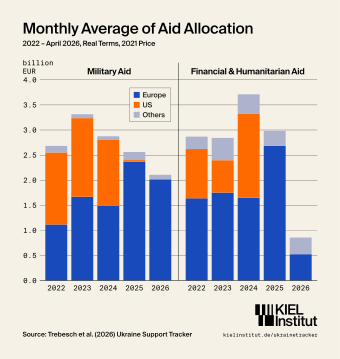
“Europe has sustained the momentum of its elevated military support for Ukraine in 2026,” says Christoph Trebesch, head of the Ukraine Support Tracker. “At the same time, financial and humanitarian aid allocations collapsed—mainly because the EUR 90 billion EU loan had been blocked for months before being formally approved in April. The key question now is how quickly European commitments will actually translate into new aid allocations.”
Drones move to the center of military aid
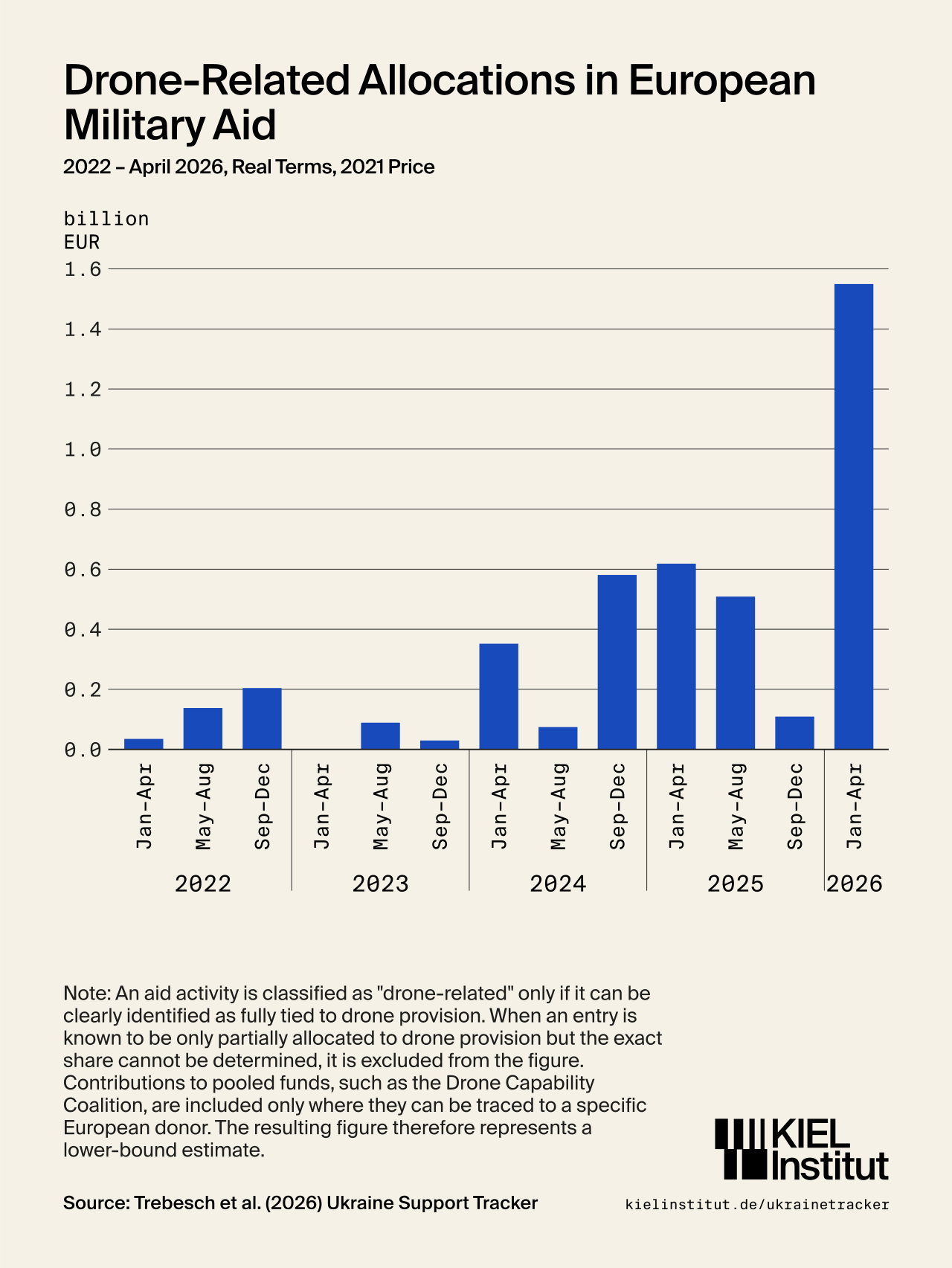
Particularly striking in March and April 2026 was the sharp rise in drone-related allocations. The United Kingdom allocated at least 120,000 drones—the largest drone allocation ever announced as part of a single allocation. Germany and Norway each allocated approx. EUR 500 million for drone procurement, while the Netherlands allocated around EUR 250 million.
The importance of drones in European military aid has increased substantially within just a few years. In real terms, confirmed bilateral military aid allocated to drones grew from EUR 400 million in 2022 to EUR 1 billion in 2024 and EUR 1.2 billion in 2025, before surging to approximately EUR 1.6 billion in the first four months of 2026 alone. These figures include only provisions that can be clearly attributed to European donors. The actual volume is therefore likely even higher.
Major donors such as Germany and the Netherlands are increasingly allocating drones jointly with Ukrainian defense firms, strengthening Ukraine while also fostering innovation in Europe.
“European donors are now entering drone financing and production on a large scale,” says Trebesch. “As a result, support for Ukraine is increasingly becoming a two-way exchange: financial aid flows to Ukraine, while technological spillovers flow back to Europe.”
About the Ukraine Support Tracker
The Ukraine Support Tracker tracks and quantifies military, financial, and humanitarian assistance pledged to Ukraine since January 24, 2022. Included are 41 countries, specifically the EU member states, the other members of the G7, Australia, South Korea, Turkey, Norway, New Zealand, Switzerland, Turkey, China, Taiwan, India, and Iceland. It includes pledges made by the governments of these countries to the Ukrainian government; aid pledged by the EU Commission and the European Investment Bank is listed separately; private donations or those from international organizations such as the IMF are not included in the main database. Nor does it include aid to Ukraine's neighbors, such as Moldova, or to other countries, such as for the reception of refugees.
Data sources include official government announcements and international media reports. Aid in kind, such as medical supplies, food, or military equipment, is estimated using market prices or information from previous relief operations. In cases of doubt, the higher available value is used. The Ukraine Support Tracker is constantly being expanded, corrected and improved. Feedback and comments on our methodology paper and dataset are very welcome. You can reach us at ukrainetracker@ifw-kiel.de.
More information and all detailed data can be found on the Ukraine Support Tracker webpage.