

Journal Article
Attainment of global diabetes targets in 2021: a pooled analysis of individual-level data from national surveys in 100 low-income, middle-income, and high-income countries
Authors
Publication Date
DOI
Key Words
Related Topics
Europe
Economic Policy in Germany
War
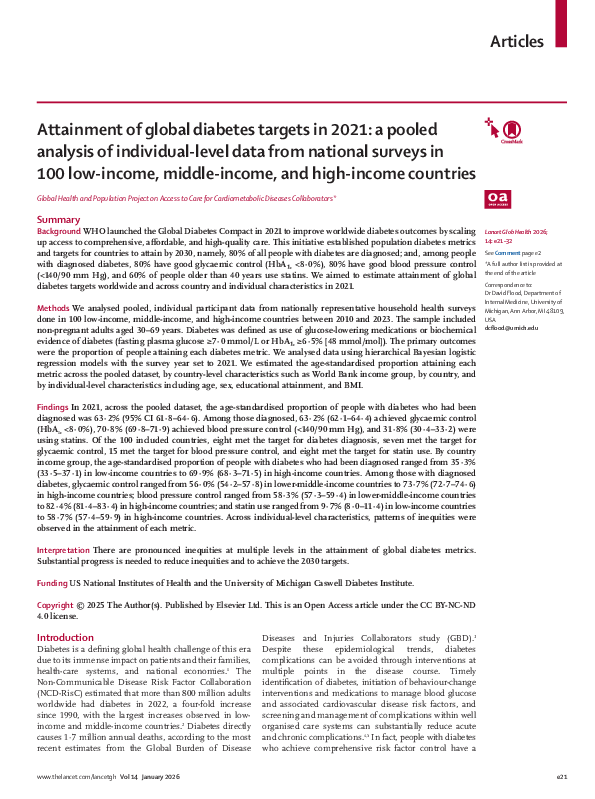
Background
WHO launched the Global Diabetes Compact in 2021 to improve worldwide diabetes outcomes by scaling up access to comprehensive, affordable, and high-quality care. This initiative established population diabetes metrics and targets for countries to attain by 2030, namely, 80% of all people with diabetes are diagnosed; and, among people with diagnosed diabetes, 80% have good glycaemic control (HbA1c <8·0%), 80% have good blood pressure control (<140/90 mm Hg), and 60% of people older than 40 years use statins. We aimed to estimate attainment of global diabetes targets worldwide and across country and individual characteristics in 2021.
Methods
We analysed pooled, individual participant data from nationally representative household health surveys done in 100 low-income, middle-income, and high-income countries between 2010 and 2023. The sample included non-pregnant adults aged 30–69 years. Diabetes was defined as use of glucose-lowering medications or biochemical evidence of diabetes (fasting plasma glucose ≥7·0 mmol/L or HbA1c ≥6·5% [48 mmol/mol]). The primary outcomes were the proportion of people attaining each diabetes metric. We analysed data using hierarchical Bayesian logistic regression models with the survey year set to 2021. We estimated the age-standardised proportion attaining each metric across the pooled dataset, by country-level characteristics such as World Bank income group, by country, and by individual-level characteristics including age, sex, educational attainment, and BMI.
Findings
In 2021, across the pooled dataset, the age-standardised proportion of people with diabetes who had been diagnosed was 63·2% (95% CI 61·8–64·6). Among those diagnosed, 63·2% (62·1–64·4) achieved glycaemic control (HbA1c <8·0%), 70·8% (69·8–71·9) achieved blood pressure control (<140/90 mm Hg), and 31·8% (30·4–33·2) were using statins. Of the 100 included countries, eight met the target for diabetes diagnosis, seven met the target for glycaemic control, 15 met the target for blood pressure control, and eight met the target for statin use. By country income group, the age-standardised proportion of people with diabetes who had been diagnosed ranged from 35·3% (33·5–37·1) in low-income countries to 69·9% (68·3–71·5) in high-income countries. Among those with diagnosed diabetes, glycaemic control ranged from 56·0% (54·2–57·8) in lower-middle-income countries to 73·7% (72·7–74·6) in high-income countries; blood pressure control ranged from 58·3% (57·3–59·4) in lower-middle-income countries to 82·4% (81·4–83·4) in high-income countries; and statin use ranged from 9·7% (8·0–11·4) in low-income countries to 58·7% (57·4–59·9) in high-income countries. Across individual-level characteristics, patterns of inequities were observed in the attainment of each metric.
Interpretation
There are pronounced inequities at multiple levels in the attainment of global diabetes metrics. Substantial progress is needed to reduce inequities and to achieve the 2030 targets.
Funding
US National Institutes of Health and the University of Michigan Caswell Diabetes Institute.