Apartment prices below prior-year level for the first time in more than two years
Germany's residential real estate market continues to cool. In the third quarter of 2026, apartments cost slightly less than in the same quarter of the previous year for the first time in more than two years. Single-family homes were traded cheaper than in the previous quarter. At the same time, fewer apartments and single-family homes are being sold, and listings remain online for longer. A long-term analysis also shows that the recovery is uneven. In high-priced cities, apartment prices are in many cases still well below their previous peaks.
These insights are based on the latest update of the GREIX sales price index, a joint project of the local expert committees for property values (Gutachterausschüsse für Grundstückswerte) and the Kiel Institute for the World Economy. The index is based on notarized transaction data from the sales price collections of the local expert committees and currently tracks price developments in 27 cities and regions. In addition, with Thuringia, the GREIX fully covers a German federal state other than a city-state for the first time. All data is freely available at greix.de.
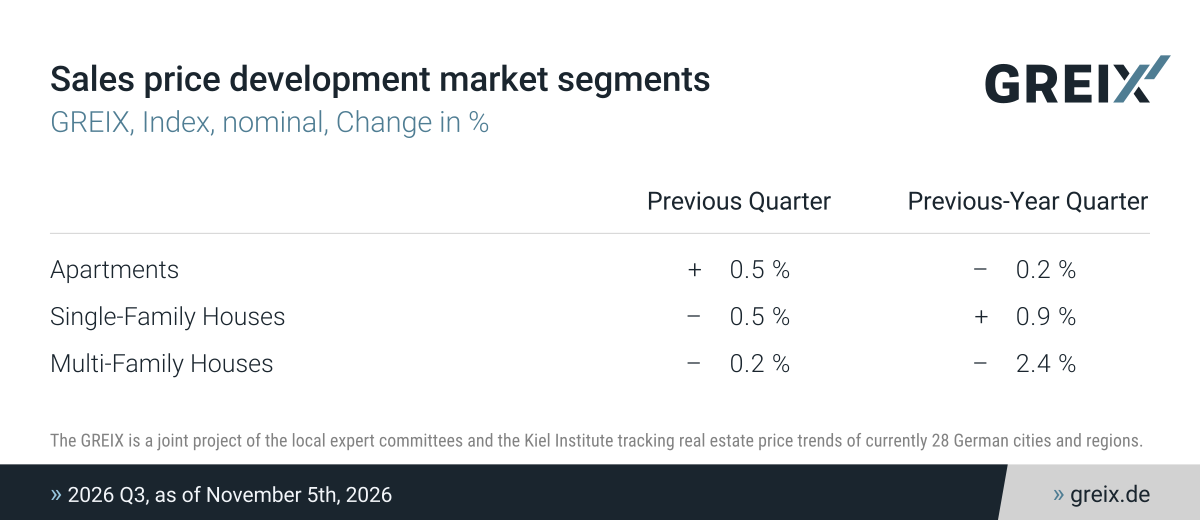
Compared to the previous quarter, nominal prices for apartments rose by 0.5 percent. Single-family homes were traded 0.5 percent cheaper, multi-family homes 0.2 percent cheaper. Compared to the same quarter of the previous year, apartments were down 0.2 percent and thus below the prior-year level for the first time since the second quarter of 2024. Single-family homes were still 0.9 percent above the prior-year level, while multi-family homes were 2.4 percent below. Given the low number of transactions, the figures for multi-family homes are less conclusive.
Apartment price growth comes to a halt
The fact that apartment prices rose compared to the previous quarter yet remain below the prior-year level is explained by their development since autumn 2025. In the fourth quarter of 2025, prices fell by 0.8 percent and have since moved largely sideways. The current increase is not enough to offset this decline. At the beginning of 2025, annual price growth still stood at 3.3 percent, compared with only 0.1 percent in the second quarter of 2026.
Adjusted for inflation, that is, measured in current purchasing power, prices fell in all three segments. Compared to the previous quarter, apartments declined by 0.3 percent in real terms, single-family homes by 1.3 percent and multi-family homes by 1.0 percent. Year-over-year, the real declines amounted to 3.0 percent for apartments, 2.0 percent for single-family homes and 5.2 percent for multi-family homes.
“Price growth for apartments has practically come to a standstill. The first year-over-year decline in more than two years marks a turning point, even if the decline is still small. The listing data also points to a weaker market. Apartments and single-family homes remain listed for longer, and asking prices are being adjusted downward more frequently,” says Jonas Zdrzalek, GREIX Project Lead at the Kiel Institute for the World Economy.
Fewer sales of apartments and single-family homes
In the second quarter of 2026, for which the number of transactions has now been fully recorded, 1.7 percent fewer apartments were sold than a year earlier. For single-family homes, the decline was more pronounced at 8.2 percent. The analyses for the third quarter of 2026 indicate that this weaker development is continuing. As individual purchase contracts are recorded with a time lag, the rate of change cannot yet be determined conclusively.
Mixed trends in the major cities, Berlin down year-over-year for the third time in a row
Compared to the previous quarter, apartment prices rose by 2.8 percent in Cologne, by 2.4 percent in Frankfurt am Main and by 0.8 percent in Düsseldorf. In Berlin they fell by 0.9 percent, the steepest decline among the six major cities with current data. Stuttgart (–0.1 percent) and Leipzig (0.0 percent) remained virtually unchanged. Compared to the same quarter of the previous year, prices in Berlin were 2.9 percent lower, the third annual decline in a row. In Cologne, by contrast, they rose by 4.6 percent. In Leipzig, the annual increase slowed from 3.9 percent in the previous quarter to 0.6 percent. Since 2014, apartment prices in Leipzig have risen by almost 150 percent, more than in any other city analyzed.
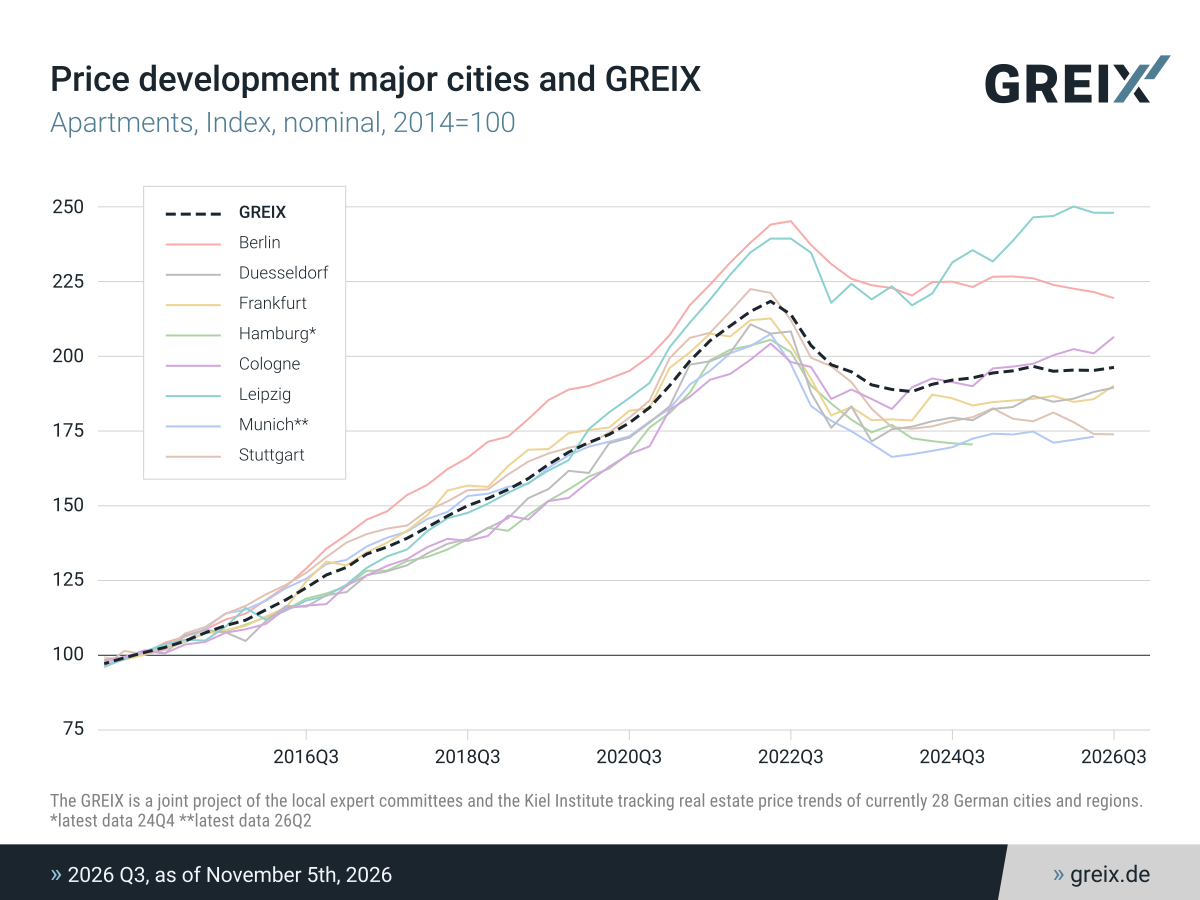
Other cities between slight gains and declines
Outside the eight largest cities, too, no uniform trend emerges. In Karlsruhe, apartment prices rose by 1.7 percent compared to the previous quarter, in Dortmund by 0.2 percent. At –0.1 percent, Lübeck remained close to the previous quarter’s level. In Münster, prices fell by 1.9 percent.
Expensive markets still have considerably more ground to make up
A special analysis covering the period up to the second quarter of 2026 reveals large differences between local housing markets. For this purpose, 24 cities and districts were divided into three groups according to their price level in 2019. In the most affordable group, prices most recently stood at a median of 3.3 percent above their previous peak. In the most expensive group, by contrast, they were still 10.2 percent below. The difference between Leipzig and Stuttgart is particularly striking. Leipzig was 3.6 percent above its previous peak, while Stuttgart was still 21.8 percent below.
“There can be no talk of a broad recovery. While some more affordable markets have already returned to their previous peaks, many expensive markets remain well below them. One possible explanation is their greater sensitivity to interest rates. Where properties were already expensive before the interest rate turnaround and offered comparatively low returns, the higher financing costs are likely to have weighed particularly heavily on prices,” says Zdrzalek.
Listing data points to declining market liquidity
In addition, the GREIX evaluates listing data from the VALUE Marktdatenbank. All liquidity indicators currently point in the same direction. In the third quarter of 2026, the average listing duration, measured as a moving average over four quarters, stood at around 94 days for apartments and 95 days for single-family homes. For apartments, this was the highest level since the second quarter of 2025, for single-family homes the highest since the first quarter of 2025. At the same time, the asking price was adjusted for 22.4 percent of apartment listings and 21.0 percent of single-family home listings. These shares have risen for five consecutive quarters. Earlier analyses show that increasing price reductions in listings tend to be associated with weaker price developments in the following quarter.
Thuringia is the first German federal state other than a city-state fully covered by the GREIX
With Thuringia, the GREIX sales price index fully covers a German federal state other than a city-state for the first time, with data reaching back to 2013. Also newly added are the district of Coesfeld with data from 2007 and the district of Gütersloh with data from 1995. The new areas are already included in the aggregate GREIX index. Their individual results will be published in the near future.
Read short report now:

Methodological note
The Greix sales price index is based on a hedonic regression method. This method mitigates the price distortions that often arise when using the average price per square meter. For example, if a large number of expensive apartments in a desirable location are sold in a given year, this can inflate the average price per square meter. However, these fluctuations may not reflect an overall increase in real estate values. Hedonic regression methods mitigate the impact of specific property characteristics on price trends.
About the GREIX
- What is the German Real Estate Index (GREIX)?
The German Real Estate Index (GREIX) is a publicly funded research project hosted at the Kiel Institute for the World Economy that aims to increase transparency in the German real estate market. To this end, GREIX regularly publishes updates on the development of sales prices (GREIX sales price index) as well as on the development of asking rents (GREIX rental price index). In addition to these price developments, GREIX publishes special analyses, for example on affordability or on price-determining factors such as location or energy efficiency. - What is the GREIX sales price index?
The GREIX sales price index is a real estate price index for Germany based on the sales price collections of the local expert committees, which contain notarized sales prices. It tracks the price development of individual cities and neighborhoods back to 1960 and is based on more than two million transaction data. The dataset can be used to analyze long-term trends in the real estate markets and to place current developments in a historical context. On greix.de, sales price indices for various market segments in currently 24 cities are freely available. The dataset will gradually be expanded to include additional cities. - What data and methods are used to create the indices?
Data collection is carried out by the local expert committees, which record all property transactions in full. Sales price analysis is conducted using state-of-the-art scientific methods and statistical techniques (hedonic regression method). The GREIX sales price index therefore represents the highest standard of scientific data quality.