
GREIX Rental Price Index Q3 2026: Asking rents pick up again, existing-stock apartments drive the trend
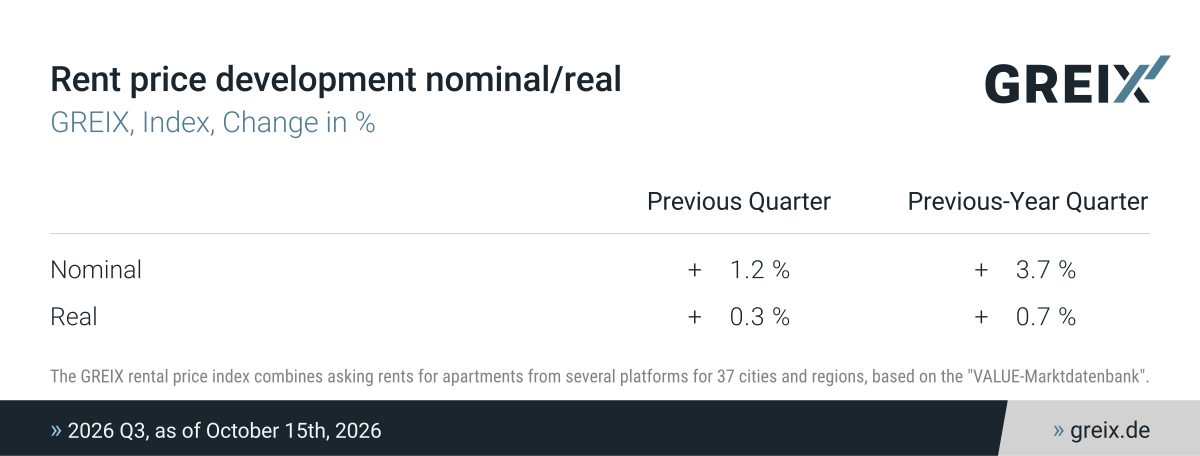
In the third quarter of 2026, asking rents in German cities gained momentum again. On average, nominal rents rose by 1.2 percent compared to the previous quarter and by 3.7 percent compared to the same quarter last year. This is the strongest quarterly increase since the first quarter of 2025 and the highest annual growth rate since the fourth quarter of 2025. Adjusted for inflation, rents rose by 0.3 percent compared to the previous quarter and by 0.7 percent compared to the same quarter last year.
These findings are based on the latest update of the GREIX (German Real Estate Index) Rental Price Index published by the Kiel Institute for the World Economy. The index analyzes asking rents for apartments in 37 German cities and regions, including the 30 most populous cities, using data from the VALUE market database.
“After the annual growth rate hovered around the three-percent mark for two quarters, rent dynamics are now picking up slightly again. The increase is driven mainly by existing stock. Rents for existing-stock apartments are currently rising markedly faster than those for new-build apartments,” says Jonas Zdrzalek, GREIX Project Lead, Kiel Institute for the World Economy.
Wide range among the eight largest cities
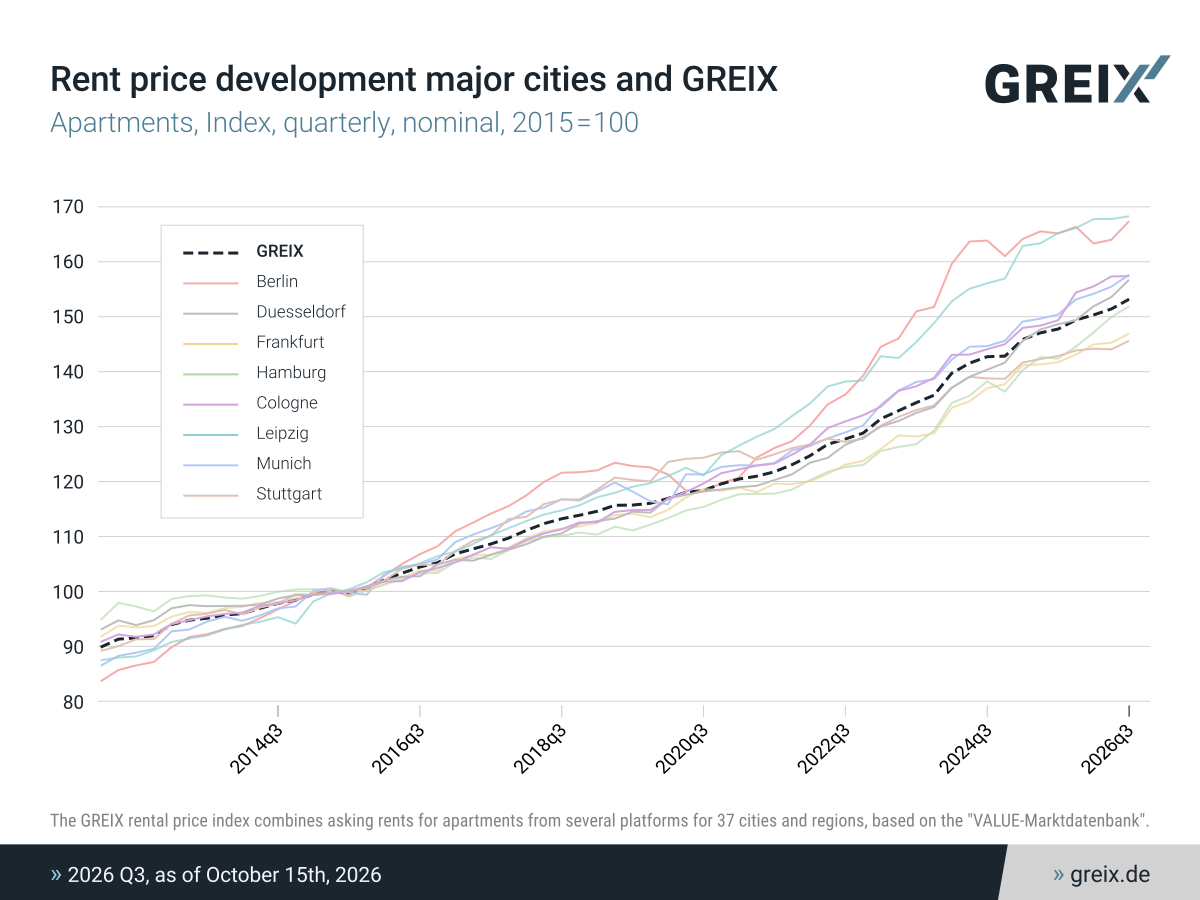
In a quarter-on-quarter comparison (Q3 2026 to Q2 2026), growth rates above the nationwide GREIX increase of 1.2 percent were recorded in Berlin (+2.1 %), Düsseldorf (+2.0 %), Munich (+1.4 %), and Hamburg (+1.3 %). Frankfurt a.M. and Stuttgart, each at +1.1 percent, were just below the average. Asking rents in Leipzig rose only slightly, by 0.3 percent, while they remained unchanged in Cologne.
In year-on-year terms, Hamburg (+6.7 %), Düsseldorf (+5.4 %), and Cologne (+5.4 %) lead the field among the eight largest cities. Munich (+4.8 %) and Frankfurt a.M. (+3.7 %) continued to record noticeable increases. Stuttgart and Leipzig, in contrast, grew by only 1.9 percent each. At +1.4 percent, Berlin is back above the previous year’s level, after asking rents there had still been below the respective prior-year figure in the first and second quarters of 2026. The gap between the strongest and the weakest major city thus amounts to just over five percentage points.
Munich remains the leader in rent levels
Munich remains the most expensive city, with an average cold rent of EUR 23.7 per square meter. Following at a significant distance are Frankfurt a.M. (EUR 17.9/m²), Hamburg (EUR 16.5/m²), and Stuttgart (EUR 16.4/m²). Cologne (EUR 16.0/m²) and Berlin (EUR 15.8/m²) represent the upper mid-range, while Düsseldorf stands at EUR 15.1/m². Leipzig marks the lower end of the eight largest cities at EUR 10.4/m².
The weighted average across all 37 cities and regions (GREIX) is currently EUR 14.6 per square meter.
Other cities with mostly rising rents
Outside the eight largest cities, increases also predominate, although their intensity varies considerably. Asking rents rose particularly strongly in quarter-on-quarter terms in Hamm (+2.3 %), Mannheim (+2.3 %), Bochum (+2.2 %), and Nuremberg (+1.9 %). Declines remained the exception and occurred in Wiesbaden (−0.8 %), Bonn (−0.4 %), and Mönchengladbach (−0.4 %).
In year-on-year terms, Bochum (+6.3 %), Augsburg (+5.6 %), and Mannheim (+5.0 %) recorded the strongest increases. Growth was weakest in Braunschweig (+0.9 %) and Bonn (+2.3 %).
In terms of rent levels, Potsdam and Augsburg, each at EUR 15.0/m², come close to the level of Düsseldorf, followed by Münster (EUR 14.7/m²) and Wiesbaden (EUR 13.8/m²). The least expensive cities are Chemnitz (EUR 6.3/m²), Gelsenkirchen (EUR 7.7/m²), as well as Duisburg and Hamm (EUR 8.6/m² each).
Existing-stock rents rise faster than new-build rents
In the third quarter of 2026, asking rents for new-build apartments developed more weakly than those for existing-stock apartments. New-build rents rose in nominal terms by 0.6 percent compared to the previous quarter and by 3.3 percent compared to the same quarter last year, while existing-stock rents rose by 1.2 and 3.7 percent, respectively. Adjusted for inflation, new-build rents fell by 0.3 percent quarter-on-quarter, while existing-stock rents rose by 0.4 percent in real terms. Year-on-year, existing stock is also ahead in real terms, at +0.7 percent compared to +0.3 percent for new builds.
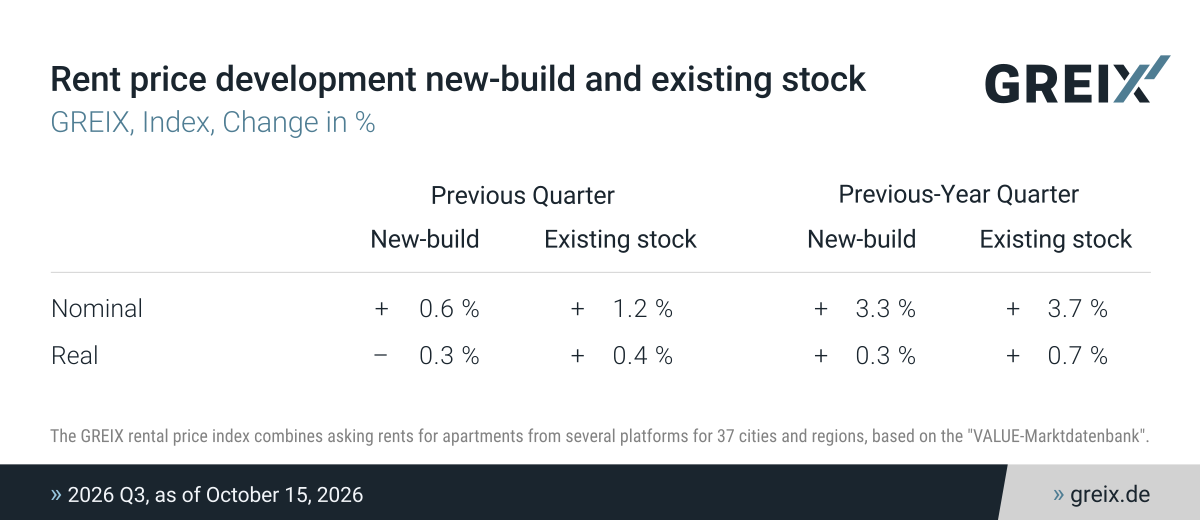
This pattern holds both in the eight largest cities and in the rest of the GREIX. In the eight largest cities, new-build rents rose by 0.9 percent compared to the previous quarter and existing-stock rents by 1.5 percent. In the remaining cities, new-build rents fell slightly by 0.1 percent, while existing-stock rents rose by 1.0 percent.
New-build apartments in major cities stay listed around two weeks longer
A look at time on market complements this picture. In the eight largest cities, new-build apartments have remained on the market around 14 days longer than existing-stock apartments on average over the last four quarters, compared to around 8 days in the remaining cities. Since reaching a low of 10 days at the end of 2023, this gap has widened again considerably in the largest cities.
“In the major cities, new-build apartments are among the most expensive offers on the rental market. At these prices, only a smaller group of households can still consider renting them, which can lengthen the time on market. Descriptively, this is consistent with the fact that new-build rents have recently risen more slowly than existing-stock rents,” says Jonas Zdrzalek.
Read short report now:
Methodological note
The price development of the GREIX rental price index is calculated as an index. This allows statistical methods (hedonic method) to be used to mitigate price distortions that often arise when using average price per square meter. For instance, if a high number of apartments in a prime location or in an extraordinary condition are sold, this can inflate average prices per square meter. However, such fluctuations may not reflect a general increase in real estate values. Using hedonic regression methods, specific property characteristics do not cause upward or downward distortions in the price trend.

About the GREIX Rental Price Index
What is the German Real Estate Index (GREIX)?
The German Real Estate Index (GREIX) is a publicly funded research project hosted at the Kiel Institute for the World Economy that aims to increase transparency in the German real estate market. To this end, GREIX regularly publishes updates on the development of sales prices (GREIX sales price index) as well as on the development of asking rents (GREIX rental price index). In addition to these price developments, GREIX publishes special analyses, for example on affordability or on price-determining factors such as location or energy efficiency.
What is the GREIX rental price index?
The GREIX rental price index is a rental price index for Germany based on asking rents for apartments from several platforms. It tracks rental price developments in individual cities and regions since 2012 and is based on several million listings. The dataset can be used to analyze trends in the rental market and to compare them with developments in the GREIX sales price index. Rental price indices for currently 37 cities and regions are freely available at `www.kielinstitut.de/greix-mietpreisindex`. The dataset will gradually be expanded to include additional cities.
What data and methods are used to compile the indices?
The VALUE Marktdatenbank provides the data foundation. It is based on an extensive collection of carefully prepared real estate market data from more than 100 sources. Asking rents are analyzed using state-of-the-art scientific methods and statistical techniques (hedonic regression method). The GREIX rental price index therefore represents the highest standard of scientific data quality.