Kiel Institute Summer Forecast: tentative recovery amid strong headwinds
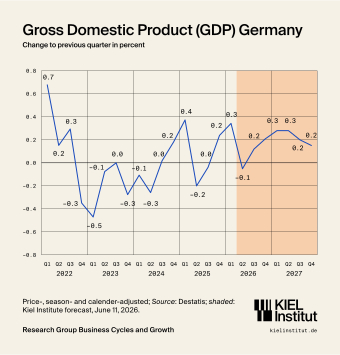
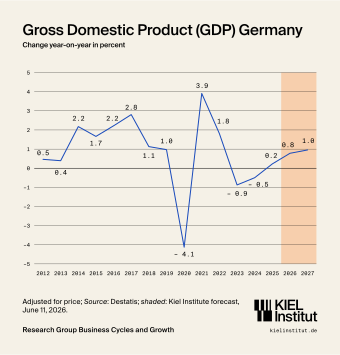
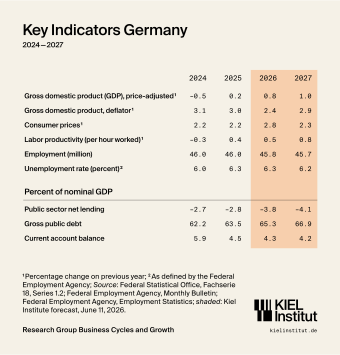
The German economy continues to face opposing forces. While fiscal policy is providing expansionary stimulus, the consequences of the Iran war are weighing on economic momentum. This is one of the key findings of the Kiel Institute’s latest Summer Forecast. Germany’s gross domestic product (GDP) is expected to grow by only 0.8 percent this year despite the expansionary fiscal stance. For next year, the economists have revised their growth projection downward from 1.4 percent to 1.0 percent. So far, there are few signs of a strong recovery in exports and business investment—developments that have typically characterized previous recovery phases. Instead, growth is expected to be driven primarily by higher public consumption and investment spending. By contrast, private investment activity remains weak, and employment prospects have deteriorated significantly.
The sharp rise in commodity prices triggered by the Iran war is currently causing noticeable losses in purchasing power, weighing on economic activity. “The consequences of the Iran war are dampening economic output,” says Moritz Schularick, President of the Kiel Institute. “The rise in commodity prices is proving to be more persistent, which will continue to constrain economic activity into next year.”
Read the economic forecasts:
- German Economy in Summer 2026: Modest momentum amid elevated risks
- World Economy in Summer 2026: Iran war still weighs on growth
Structural problems in the German economy also persist. Although exports have recently stabilized and are likely to gradually return to a moderate growth path, there is still no sign of dynamic recovery following the declines of previous years. “The declining competitiveness of the German economy will lead to further losses in global market share,” says Stefan Kooths, Head of Forecasting at the Kiel Institute. “Compared to past upswings, the expected growth rates are modest. Without far-reaching reforms to strengthen the country as a business location, the German economy risks drifting into a phase of weakening growth forces and increasing distributional conflicts.”
Rising inflation, moderate growth in exports
The sharp increase in commodity prices is reflected in higher inflation. The Kiel Institute expects inflation to reach 2.8 percent this year and remain elevated at 2.3 percent next year. Export growth will be modest, with exports expected to increase by only 1.8 percent over the year.
Private consumption barely growing, slight increase in construction investment
Private consumption is barely increasing, as higher commodity prices reduce purchasing power. This is also reflected in a deteriorating consumer climate. A slight increase of 0.3 percent is expected for this year, and 0.4 percent for the following year. Growth in construction investment is also dampened by rising commodity prices. For 2026, despite the infrastructure special fund, only a modest increase of 0.3 percent is expected, followed by a projected rise of 1.9 percent in 2027.
Weakened labor market outlook, rising public debt
Labor market prospects have also worsened. The number of employed people is expected to be 330,000 lower by the end of the forecast period than projected in the spring. The Kiel Institute expects an average unemployment rate of 6.3 percent this year, with a slight decline to 6.2 percent next year. At the same time, public budget deficits are widening significantly: the expansionary fiscal policy stance is projected to increase the budget deficit from 2.8 percent of GDP in 2025 to 4.1 percent in 2027.
Global economy: temporary noticeable slowdown
According to the Kiel Institute’s forecast, global economic growth will slow to 2.8 percent this year (2025: 3.4 percent). This is mainly due to a sharp drop in production in countries around the Persian Gulf, while economic activity in advanced economies and most emerging markets is only slightly weakening. For 2027, assuming a resolution of the conflict with Iran, global growth is expected to recover to 3.3 percent.