

GREIX Rental Price Index Q4 2025: Record share of temporary and furnished listings
As of the end of 2025, asking rents in German cities rose faster than general inflation. Compared to the previous quarter, rents increased by an average of 1.0 percent nationwide, and by as much as 4.5 percent year-on-year. Inflation was noticeably lower. At the same time, the number of rental listings declined significantly, while the share of temporary and furnished rental offers reached a record level.
These findings are based on the latest update of the GREIX Rental Price Index published by the Kiel Institute for the World Economy. The index analyzes asking rents for apartments in 37 German cities and regions using data from the Value Marktdatenbank.
In the fourth quarter of 2025, asking rents for apartments rose by 1.0 percent compared to the previous quarter (Q3 2025). Adjusted for inflation, this corresponds to a real increase of 0.7 percent.

Compared to the same quarter of the previous year (Q4 2024), the increase was particularly pronounced: Rents were 4.5 percent higher in nominal terms and 2.3 percent higher in real terms.
“Tenants are currently facing difficult conditions,” says Jonas Zdrzalek, project leader of GREIX at the Kiel Institute for the World Economy. “Supply is shrinking, prices are rising, and rental conditions are becoming tougher as temporary contracts and furnished apartments become more widespread.”
Wide disparities across major cities
In seven of Germany’s eight largest cities, asking rents increased compared to the previous quarter. The strongest rises were recorded in Cologne, up 3.4 percent, and Munich, up 1.9 percent. In Hamburg and Frankfurt am Main, rent increases were broadly in line with the nationwide average of 1 percent. Düsseldorf posted a marginal decline of 0.1 percent.
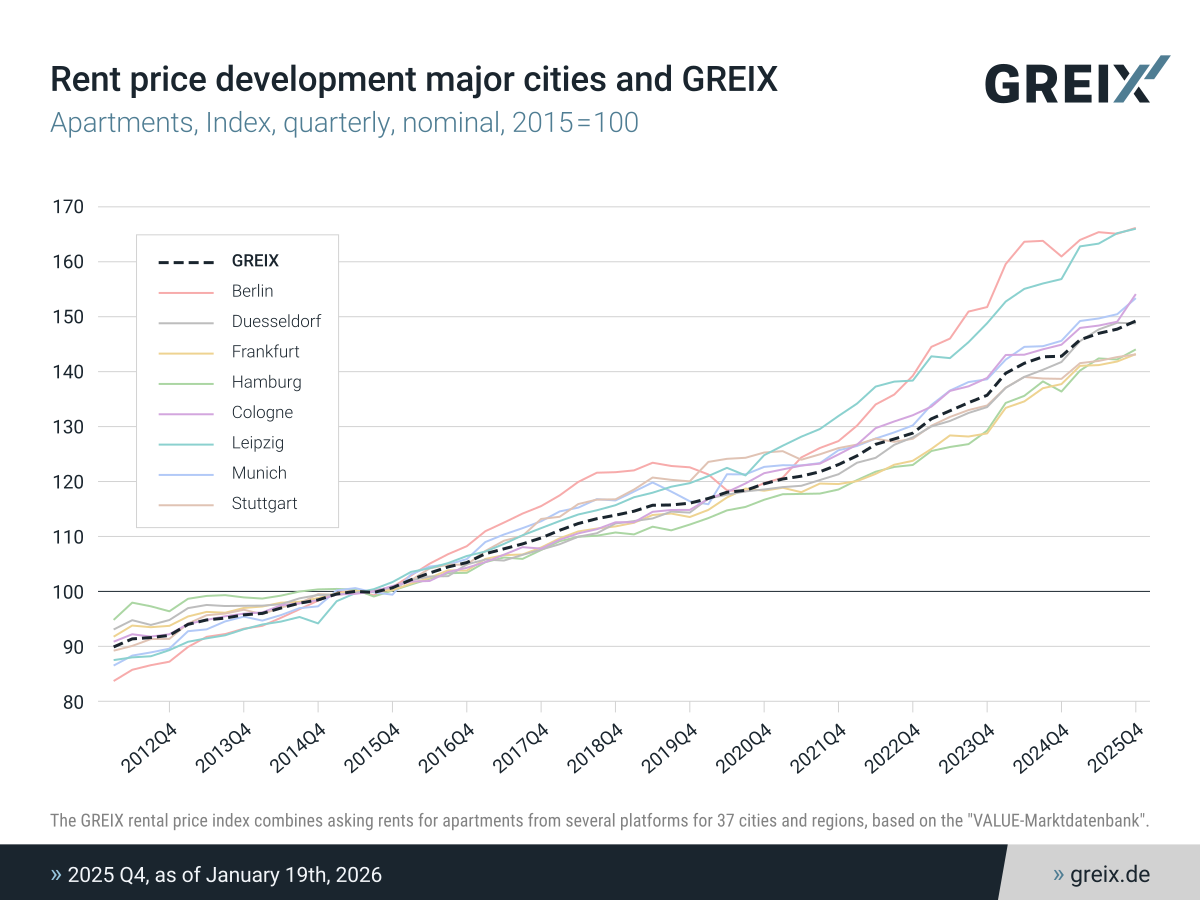
Munich recorded the highest average net rent at 23.35 euros per square meter, followed by Frankfurt am Main at 17.36 euros. Leipzig remained at the lower end of the scale with 10.22 euros per square meter. Across all 37 cities and regions covered, the GREIX average stood at 14.41 euros per square meter.
Fewer listings, more temporary rentals
The number of rental listings fell sharply by more than 10 percent compared to the previous quarter (Q3 2025). Compared to the same quarter a year earlier (Q4 2024), the decline amounted to 7 percent. In the long-term comparison, the number of rental listings is currently around 20 percent below the level seen in 2015.
At the same time, the share of temporary contracts and furnished apartments reached a record high. Nationwide more than 17 percent of all listings now fall into this category—almost one in five offers. In the eight largest cities, the share was close to one quarter, and in Munich around one third.
“The tight rental market in major cities is likely to become an increasing burden, particularly for low-income households and people in education or training,” says Zdrzalek. “Skilled workers from Germany and abroad may also find it difficult to relocate. The continuing decline in rental supply may also indicate that tenants with long-standing contracts are holding on to their apartments whenever possible.”
All evaluation data from the GREIX rental price index is available at www.kielinstitut.de/greix-mietpreisindex. New additions as of today include further information on price distribution, such as the median.
Read short report now:

About the GREIX Rental Price Index
What is the GREIX rental price index?
It is a rental price index for Germany based on asking rents for apartments from various platforms. Since 2012, it has tracked rental price developments in individual cities and is based on several million listing data points. This dataset can be used to analyze rental market trends and compare them with price developments in the GREIX purchase price index.
What data and methods are used to compile the indices?
The evaluation is based on the VALUE Marktdatenbank. This extensive database contains carefully prepared real estate market data from over 100 sources. Prices are evaluated using the latest scientific methods and statistical procedures, such as the hedonic regression method. Thus, GREIX stands for the highest scientific data quality.
Who finances the GREIX rent index?
It is a project of the Kiel Institute for the World Economy. The goal is to increase transparency in the rental market. Different indices for 37 cities and regions are freely accessible at https://www.kielinstitut.de/greix-mietpreisindex. The dataset will gradually be expanded to include more cities.
Methodological note:
The price development of the GREIX Rental Price Index is calculated as an index. This allows statistical methods (hedonic method) to be used to mitigate price distortions that often arise when using average price per square meter. For instance, if a high number of apartments in a prime location or in an extraordinary condition are sold, this can inflate average prices per square meter. However, such fluctuations may not reflect a general increase in real estate values. Using hedonic regression methods, specific property characteristics do not cause upward or downward distortions in the price trend.