

Policy Article
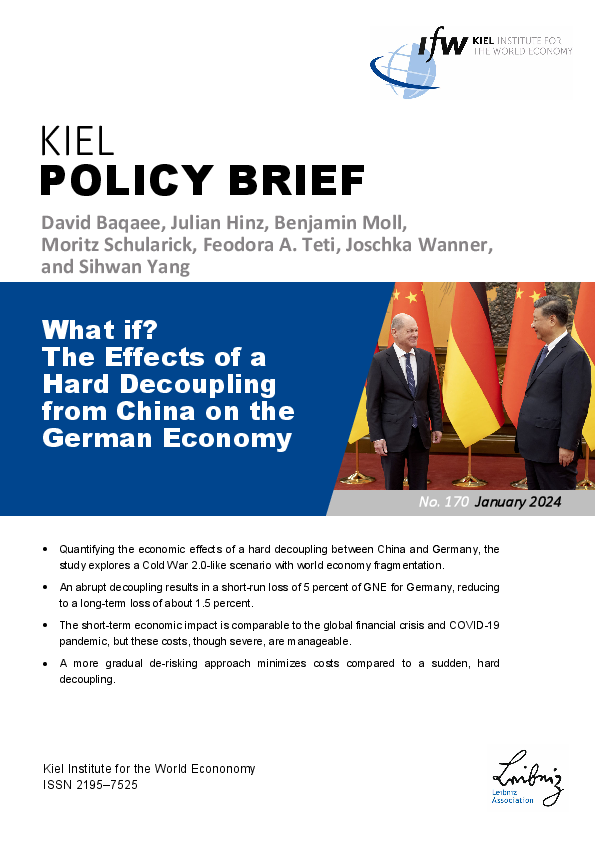
What if? The Effects of a Hard Decoupling from China on the German Economy
Authors
Publication Date
JEL Classification
Key Words
Related Topics
Geoeconomics
Asia
China
Germany
Globalization
International Trade
Economic Policy in Germany
How would the German economy cope with a hard economic decoupling from China? The authors study a scenario where the global economy fragments into three distinct blocs: the G7 economies and their allies, China and her allies, as well as neutral countries. German trade with China would have to be entirely rerouted to countries within the "Western" block and neutral countries. The authors quantify the costs of such a worst-case hard decoupling using the (Baqaee and Farhi 2021) multi-sector model of the world economy. The key finding is that a total cut-off of trade relations with China would have severe but not devastating effects on the German economy. The welfare loss for Germany (relative to a no-cut-off baseline) would be around 5 percent of Gross National Expenditure (GNE) over the first few months and around 4 percent over the first year, plus additional short run costs due to business-cycle amplification effects. In the medium and long run, the costs would fall to a permanent loss in the 1–2 percent range. Less extreme decoupling or gradual de-risking scenarios (“small yard, high fence") would incur smaller costs. The single most influential assumption relates to the “trade elasticity,", i.e., the ease and speed with which trade can be reorganized away from China to neutral countries and within the “Western” block. The authors´ findings, in particular the critical dependence of economic costs on the time horizon over which adjustments take place, provide some rationale for embarking on a gradual de-risking trajectory to avoid a costly and politically contentious hard decoupling dictated by geopolitical events.