
Strait of Hormuz closure triggers global supply shock with disproportionate food security risks
The closure of the Strait of Hormuz—a chokepoint just 21 nautical miles wide through which roughly one-fifth of global oil and one-quarter of liquefied natural gas flows—has triggered a far-reaching supply shock. A new analysis and an interactive website by the Kiel Institute show that the disruption extends well beyond energy, cascading through chemicals and fertilizers into food systems, with the most severe consequences falling on developing economies.
“The key issue is the chain reaction,” says Julian Hinz, head of the Trade Policy Research Group at the Kiel Institute. “An energy shock quickly becomes a fertilizer shock and then a food crisis—especially in countries that depend on imports at every stage.”
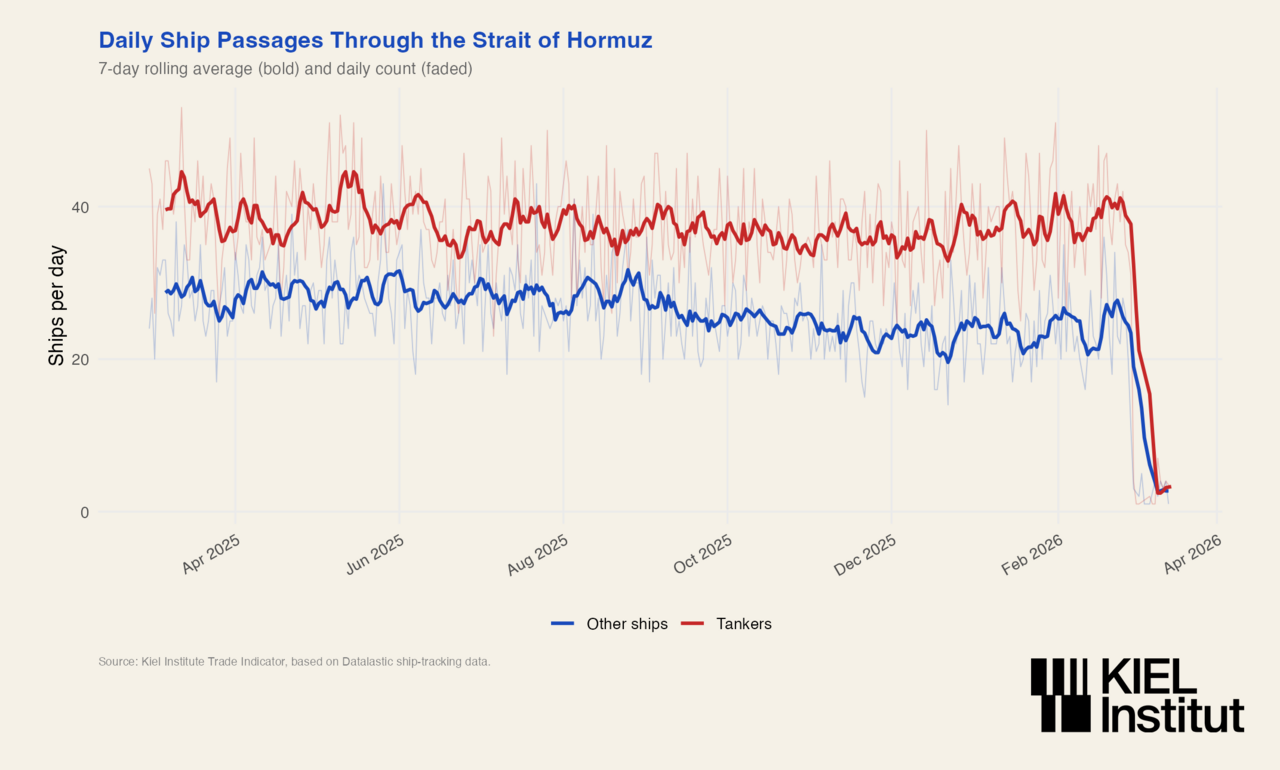
The shutdown follows the escalating conflict involving the United States, Israel, and Iran, which brought tanker traffic through the strait from around 40 daily passages to near zero within days. While attention has focused on oil and gas, the Gulf’s role in global trade runs much deeper. A small group of countries connected to the strait dominates exports in a wide range of critical products, from petrochemicals and fertilizers to metals and agricultural goods—many of which cannot be quickly sourced elsewhere.
To illustrate the full scope of this dependence, the Kiel Institute has launched a new interactive website mapping global reliance on products linked to the Strait of Hormuz.
This broader dependence is central to understanding the scale of the shock. Hydrocarbon derivatives, methanol, and urea fertilizers—key inputs into agriculture and manufacturing—are heavily concentrated in Gulf production. Energy-intensive metals such as aluminum and steel, as well as region-specific agricultural products, further anchor the Gulf’s position in global supply chains. In many of these sectors, dependence has increased over the past three decades, not declined.
Standard trade models underestimate the consequences because they miss how disruptions propagate through these tightly linked systems. Reduced energy flows constrain chemical production, which in turn limits fertilizer availability and drives up food prices, creating a bottleneck effect.
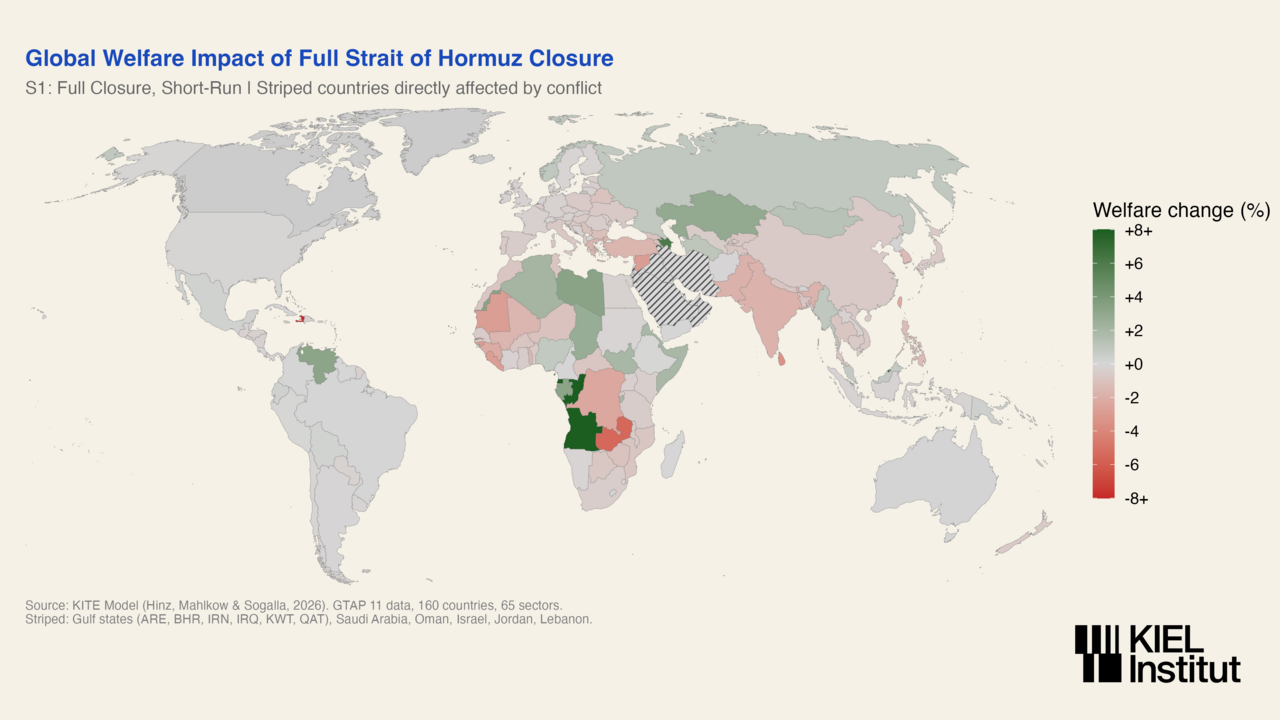
This effect amplifies the impact on countries that rely on imported inputs, particularly in South Asia, Sub-Saharan Africa, and parts of the Middle East. For example, under a short-run full closure scenario of the Strait of Hormuz, food prices in Sri Lanka, Pakistan, and India could rise by about 10–15 %, with higher increases possible. Welfare losses in these three countries are estimated to be between −3.5 % and −1.8 %. More broadly, welfare losses in these regions are estimated to be 10–20 times larger than in advanced economies, except in the case of oil-exporting countries.
For comparison, welfare effects in the European Union range only between −0.76 % and −0.36 %, while in the United States they are even smaller, ranging from −0.16 % to −0.04 %.
The timing of the disruption makes the situation especially acute. March and April are peak months for fertilizer application in the Northern Hemisphere planting season. Although some market adjustment may occur over time, structural damage to supply chains and agricultural production is likely to persist.
The findings underscore the need for coordinated policy action. The Hormuz disruption is not only an energy shock, but also a manufacturing and food security crisis. Strategic fertilizer reserves in import-dependent countries, alongside stronger international mechanisms for rapid fertilizer and food aid deployment, could help mitigate future shocks. At the same time, reducing dependence on Gulf energy and energy-intensive imports through diversification, renewable investment, and efficiency gains remains the most effective long-term response.
“The central issue is not the global average impact, but its distribution,” Hinz says. “What appears manageable globally becomes a severe food security crisis for the world’s poorest countries.”