

Energy price shock dampens recovery – inflation rises
Although the leading economic research institutes consider the German economy to be in a recovery phase following a downturn lasting several years, they nevertheless expect only a moderate increase in gross domestic product of 0.6 percent for 2026 and 0.9 percent for 2027. “The energy price shock triggered by the Iran war is hitting the recovery hard, but at the same time expansionary fiscal policy is bolstering the domestic economy and preventing a stronger slide,” says Timo Wollmershäuser, Head of Forecasts at the ifo Institute. The institutes estimate that the inflation rate will rise to an average of 2.8 percent in 2026 and 2.9 percent in 2027.
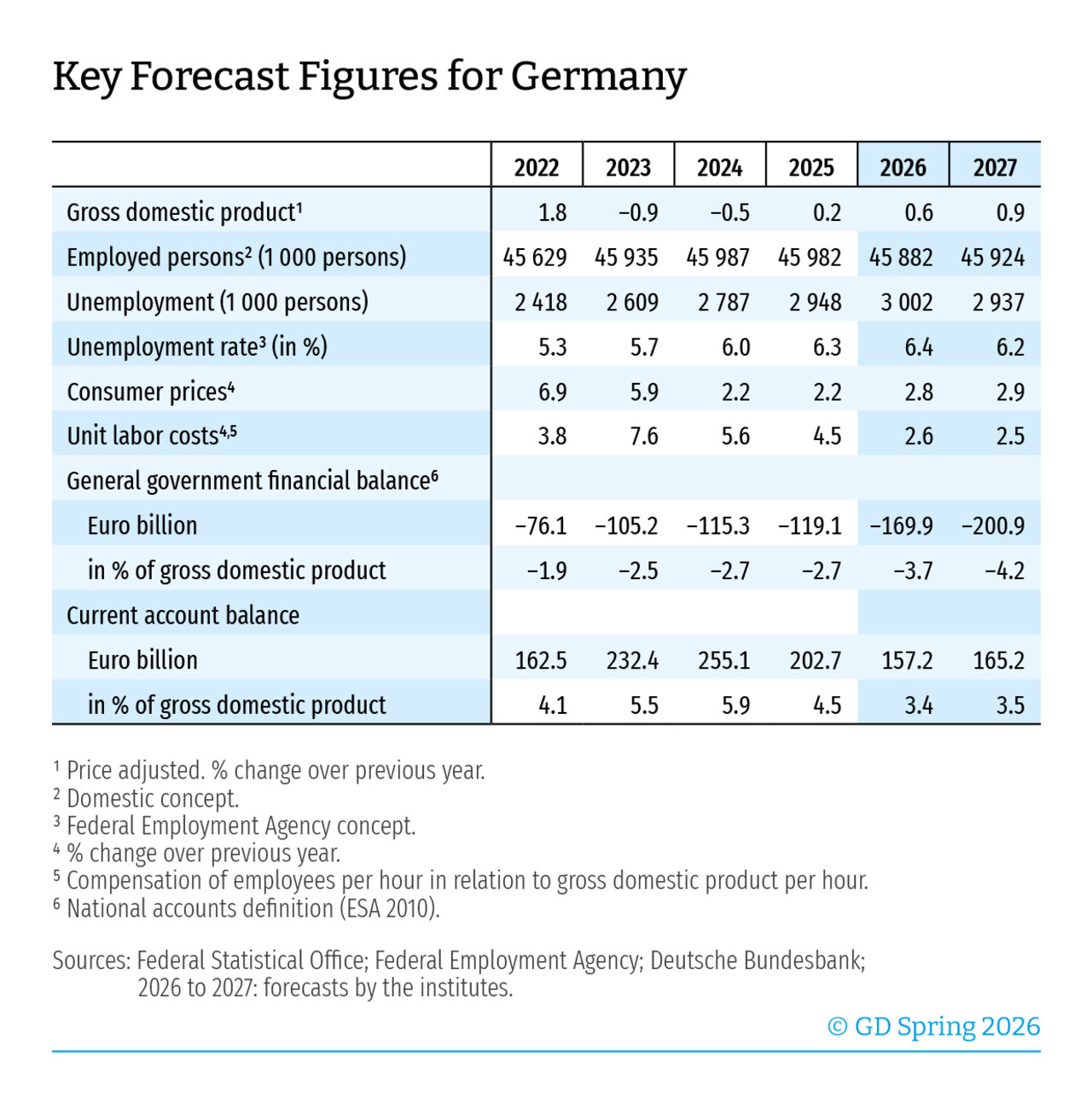
While higher inflation is dampening private consumption, the expansionary fiscal policy is providing stimulus. The strong expansion in new debt for defense, infrastructure, and climate protection is bolstering companies in the defense industry and civil engineering. Overall, however, industry is developing less dynamically since its international business is barely expanding given the continued decline in competitiveness, high geopolitical uncertainty, and persistent trade policy burdens.
In the medium term, the institutes expect growth in Germany’s production potential – currently at 0.2 percent – to come to a complete standstill by the end of the decade. According to the institutes, in addition to the decline in the working-age population due to demographic factors, the decrease in working hours per person in employment is also contributing to that. This is primarily due to the fact that older employees with below-average weekly working hours account for an increasing share of the total number of hours worked. These structural changes are compounded by cyclical factors in the labor market. The institutes anticipate a slight decline in employment of around 100,000 in 2026, followed by an increase of about 42,000 in 2027. The unemployment rate will rise to 6.4 percent in 2026 before falling to 6.2 percent next year.
According to the institutes, the massive new debt will push the public budget deficit to 3.7 percent of gross domestic product (GDP) in 2026 and 4.2 percent in 2027, raising gross debt to 67.2 percent of GDP. The institutes assess the fiscal stimulus as a key economic boost. However, they point to the long-term risks to the stability of public finances and the significant consolidation efforts that will be required toward the end of the decade.
In light of rising energy costs, the leading economic research institutes argue against government interventions that lower energy prices in the short term, as they would nullify important market signals. Instead, they advocate targeted social compensation measures. According to the institutes, a growth policy that removes regulatory curbs on private economic activity is required so that potential reserves can be leveraged. To enable that, work incentives should be strengthened and the conditions for investment and innovation improved.
Appendix
Full-length version of the report:
Joint Economic Forecast Project Group: Energy price shock overshadows fiscal stimulus – Growth drivers dry up, Spring 2026. Munich 2026.
The full-length version of the report will be available on 01 April 2026 at 10:00 a.m. at www.gemeinschaftsdiagnose.de/category/gutachten/.
About the Joint Economic Forecast
The Joint Economic Forecast is published twice a year on behalf of the German Federal Ministry for Economic Affairs and Energy. The following institutes participated in the spring report 2026:
- German Institute for Economic Research (DIW Berlin)
- ifo Institute - Leibniz Institute for Economic Research at the University of Munich in cooperation with Austrian Institute of Economic Research (WIFO)
- Kiel Institute for the World Economy
- Halle Institute for Economic Research (IWH) – Member of the Leibniz Association
- RWI – Leibniz Institute for Economic Research in cooperation with the Institute for Advanced Studies Vienna