

Ukraine Aid: EU support is crucial, but harder to access
Ukraine is increasingly dependent on EU financing as other major donors have sharply reduced their support. Total budget support is expected to fall by about 25 percent in 2026, despite growing financing needs. For 2027, the European Commission estimates a financing gap in Ukraine’s budget of about EUR 70 billion. At the same time, stricter EU reform conditions have contributed to growing payment delays, with disbursements more than EUR 10 billion behind schedule in October. A new Kiel Policy Brief suggests that delays in Ukraine aid are likely to continue, meaning Ukraine could still face a severe budget squeeze in 2027 even if the EU agrees on a new EUR 45 billion loan.
The EU has become Ukraine’s main budget supporter as other donors step back
The EU institutions have become Ukraine's dominant source of foreign budget support, moving from just 28 percent in 2022 to 65 percent in 2025; which corresponds to EUR 28.8 billion, including EUR 18.1 billion from the one-off ERA loan. In 2026, EU institutions are expected to provide slightly more than EUR 20 billion (61%), if the instalment approved on 16 November is paid by year-end.
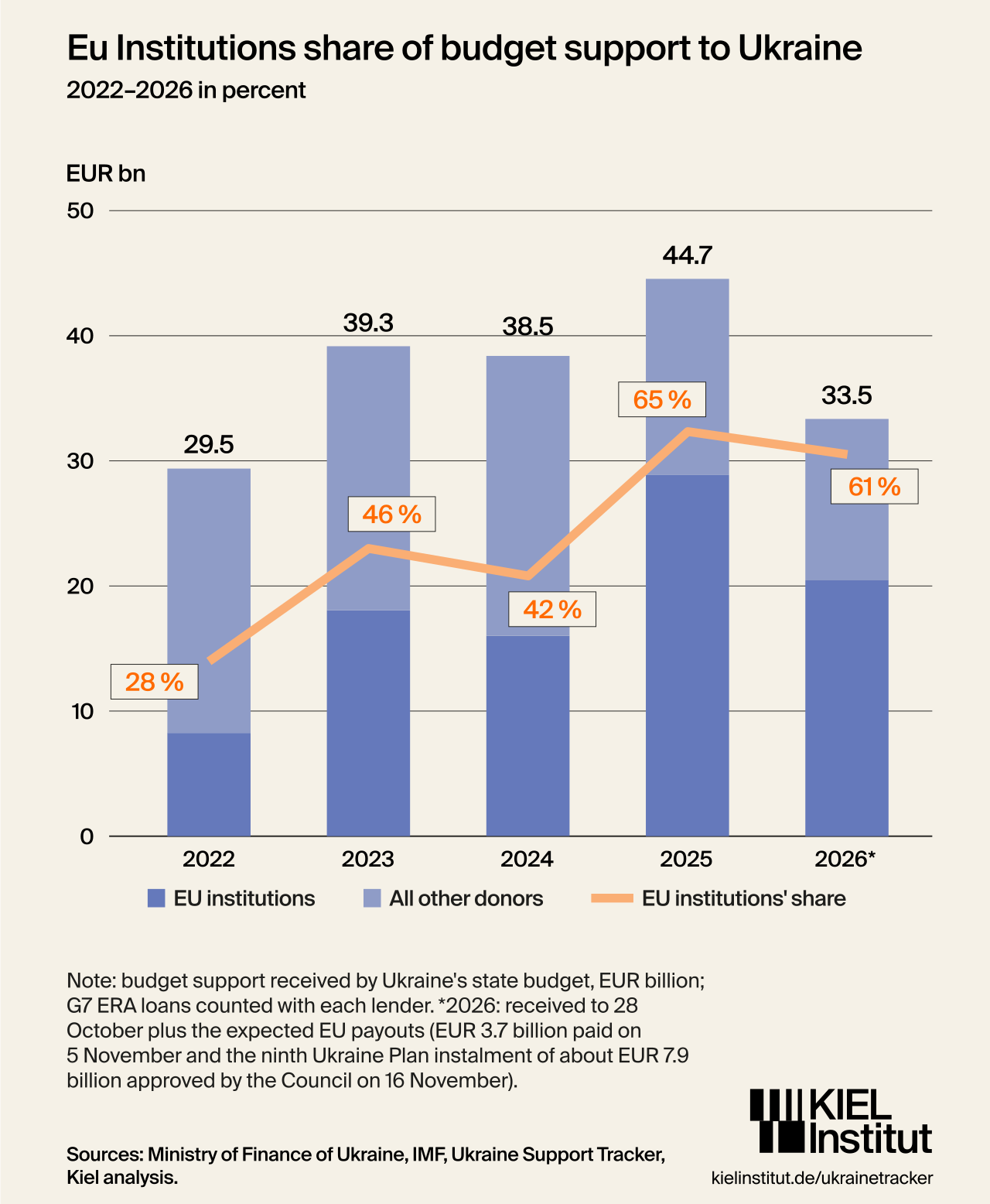
Conversely, the other donors have progressively stepped back. The United States, the largest budget donor in 2022, has committed no new budget support since 2024, and the International Monetary Fund (IMF) and the World Bank have scaled back: in 2025, Ukraine repaid more to the IMF than it received. While EU member states cumulatively paid just EUR 0.5 billion directly into Ukraine’s budget from 2023 to 2026, their support was predominantly provided in terms of military aid allocations, amounting to EUR 71.6 billion. EU Budget support includes grants and loans paid into Ukraine’s state budget, finances pensions, public wages, and essential civilian services.
“The EU has become the last lender standing for Ukraine’s civilian state,” says Christoph Trebesch, head of the Ukraine Support Tracker. “No other donor is ready to step in. Any shortfall or delay in EU money in 2027 will hit Ukraine’s budget hard.”
EU makes reforms a central financing condition
The EU is attaching more and deeper reform conditions to its budget support. The number of EU budget support conditions that Ukraine fully met under EU budget support rose from 4 in 2022 and 12 in 2023 to 37 in 2024, 45 in 2025, and 62 in 2026. The number of high-depth conditions fulfilled, which require lasting institutional changes grew even faster: from none in 2022 and 2023 to 5 in 2024, 16 in 2025, and 18 in 2026, accounting for 29 percent of all fulfilled conditions that year.
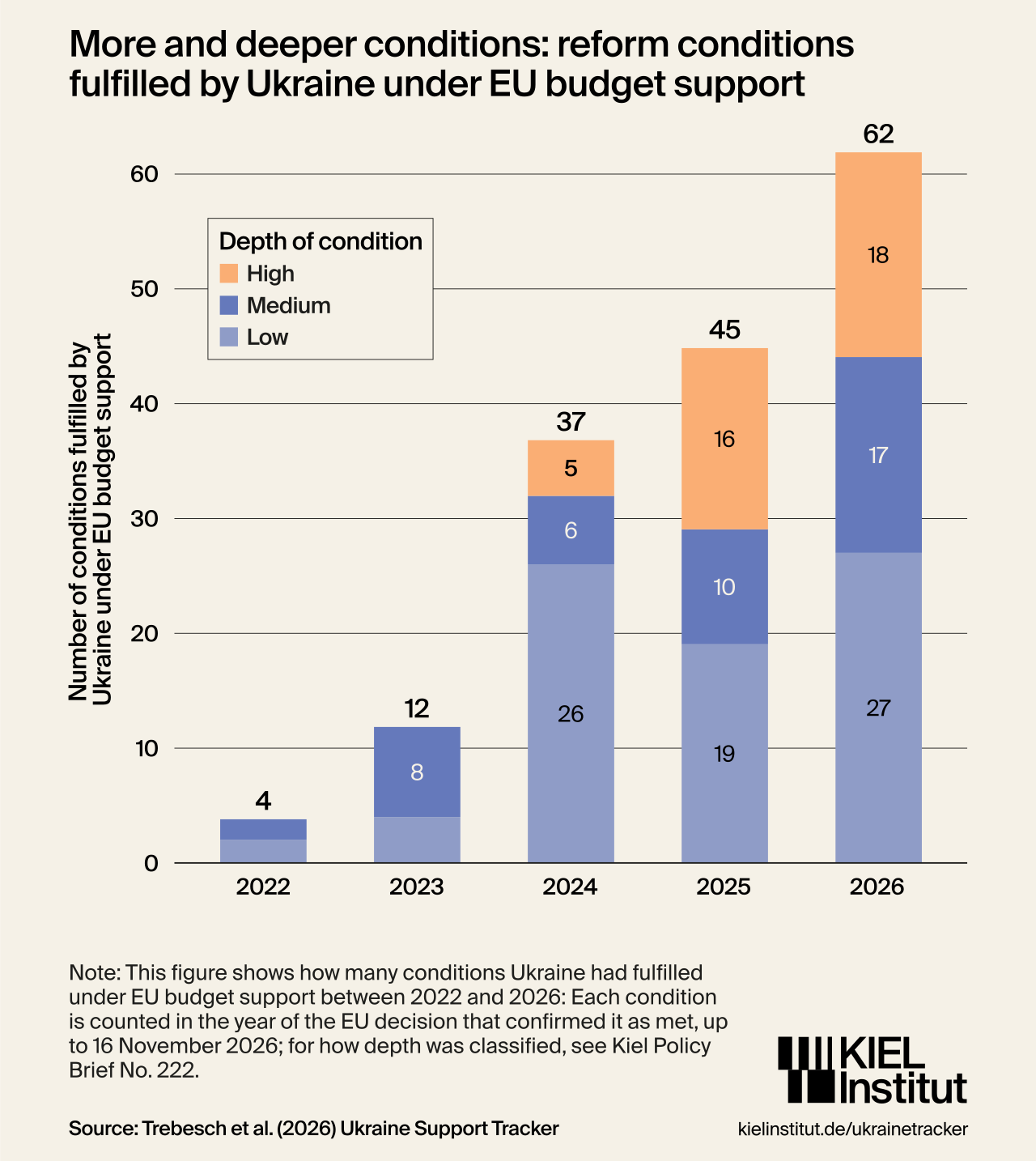
As EU conditions have become stricter, Ukraine has increasingly fallen behind schedule. Under the Ukraine Facility, the first three instalments were approved within three months of their reform deadlines and paid out in full. For the three most recent instalments, approval came about five months after the deadline on average, and around 21 percent of the instalment amount was withheld. However, these delays do not necessarily indicate weak reform performance of Ukraine. In fact, Ukraine performs well in an international comparison. An analysis of comparable EU financing instruments supporting EU accession shows that Ukraine has achieved higher reform completion rates than six of the seven EU accession countries examined, all of which are at peace.
“Ukraine is a country at war that completes reforms on time more often than peacetime recipients, yet the money arrives later and later,” says economist Christoph Trebesch. “Linking payments to reforms is right, but the EU must balance its demands with timely and predictable support. In 2027, the timing of when the money arrives will matter as much as how much is promised. Our data suggest a real risk that payment delays will persist or worsen. If this happens, Ukraine could still face a serious funding gap in 2027, even if the EU agrees on the new loan.”
Read Kiel Policy Brief now:
About the Ukraine Support Tracker
The Ukraine Support Tracker tracks and quantifies military, financial, and humanitarian assistance pledged to Ukraine since January 24, 2022. Included are 41 countries, specifically the EU member states, the other members of the G7, Australia, South Korea, Turkey, Norway, New Zealand, Switzerland, Turkey, China, Taiwan, India, and Iceland. It includes pledges made by the governments of these countries to the Ukrainian government; aid pledged by the EU Commission and the European Investment Bank is listed separately; private donations or those from international organizations such as the IMF are not included in the main database. Nor does it include aid to Ukraine's neighbors, such as Moldova, or to other countries, such as for the reception of refugees.
Data sources include official government announcements and international media reports. Aid in kind, such as medical supplies, food, or military equipment, is estimated using market prices or information from previous relief operations. In cases of doubt, the higher available value is used. The Ukraine Support Tracker is constantly being expanded, corrected and improved. Feedback and comments on our methodology paper and dataset are very welcome. You can reach us at ukrainetracker@ifw-kiel.de.
More information and all detailed data can be found on the Ukraine Support Tracker webpage.


