

Global Jobs Index 2026 — A turning point for Africa: more people are finding work, and poverty can fall
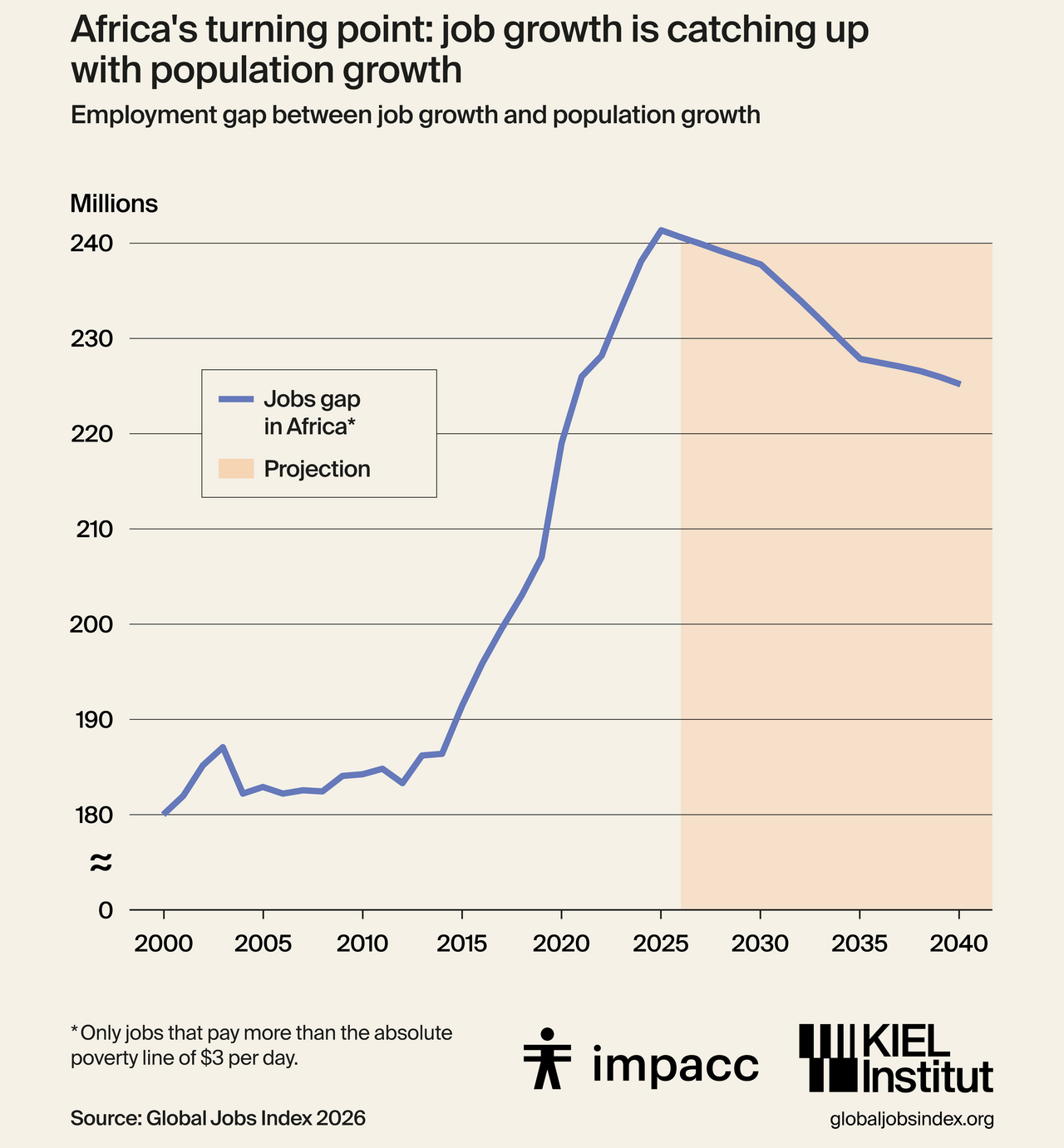
Africa’s labor market is at a turning point. For ten years, the number of people without a job that lifts them out of extreme poverty has grown. From now on, at least as many jobs above the poverty line are being created as people are entering the labor market. This is the finding of the Global Jobs Index, developed by the Kiel Institute for the World Economy and Impacc.
“For ten years, growth was too weak to create enough jobs. Now growth is picking up again and creating demand that translates into jobs,” explains Prof. Dr. Tobias Heidland, Director of the Research Center for International Development at the Kiel Institute, who is responsible for the Global Jobs Index’s scientific work.
In 2025, the number of people who are unemployed or live in extreme poverty despite working reached a peak of around 241 million. Expected economic growth means this number will stop rising as more jobs are created. As a result, the share of people without a job that lifts them out of extreme poverty is projected to fall from 40 percent in 2025 to 30 percent in 2035.
“Every new job means greater independence for people and families locally. More work and growth in the region also reduce dependence on the Global North,” says Dr. Till Wahnbaeck, founder of the nonprofit organization Impacc, which supports startups in Africa and co-developed the Global Jobs Index.
160 million jobs by 2035—but not everywhere equally
Between 2015 and 2020, income per person in Africa barely grew, partly because of the pandemic. Reforms and greater demand in global markets are now bringing renewed growth, with jobs above the poverty line projected for more than 160 million additional people by 2035. Yet African countries are developing differently. This is reflected in the jobs gap: it measures the number of people who are looking for work but cannot find it, together with those who work but whose households have less than 3 dollars per person per day to live on.
Over the next decade, the gap will narrow in Ethiopia, Tanzania, Kenya, and Nigeria, meaning more people will enjoy a better quality of life. In the Democratic Republic of the Congo and Madagascar, however, the gap is projected to grow by 2035, leaving more people in a precarious situation.
The Global North should therefore target its support to African countries accordingly. “Development cooperation must recognize local needs while aiming for measurable results on the ground. A job is the best route out of poverty,” says Till Wahnbaeck of Impacc.
AI—growth without job losses
AI’s impact on Africa’s labor market is limited. “Unlike in Europe, AI can displace very little human labor in Africa. There are simply too few of the kinds of jobs that AI can take over,” explains Prof. Dr. Tobias Heidland. Generative AI mainly replaces office, administrative, and IT tasks. Only 13 percent of workers in African countries are in occupations that AI could largely take over.
About the Global Jobs Index
The Global Jobs Index (GJI), a joint project of the Kiel Institute and the social enterprise Impacc, measures how many people in 97 low- and middle-income countries lack a job that lifts them out of extreme poverty. For the first time, the 2026 edition estimates the impact of generative AI through 2060. The interactive index is available online at https://www.globaljobsindex.org
Methodology
The GJI is based on labor market data from the International Labour Organization (ILO) and national statistical offices, as well as World Bank data. Figures through 2025 are based on ILO estimates; subsequent figures are projections. They follow the SSP3 growth scenario and hold unemployment at its 2025 level.
About Impacc
Impacc aims to establish a new form of global aid—one that empowers rather than provides. The nonprofit organization converts donations into equity investments in African startups. Its goal is to create sustainable jobs and strengthen local independence. It invests in local founders with ideas for local markets, providing financial, technical, and operational support. The model combines traditional development cooperation with venture capital principles. Impacc (https://impacc.org/de/) was founded by a team led by former Welthungerhilfe CEO Till Wahnbaeck. Its headquarters are in Hamburg with teams also working in Kenya and Ethiopia.