Klaus Schwab
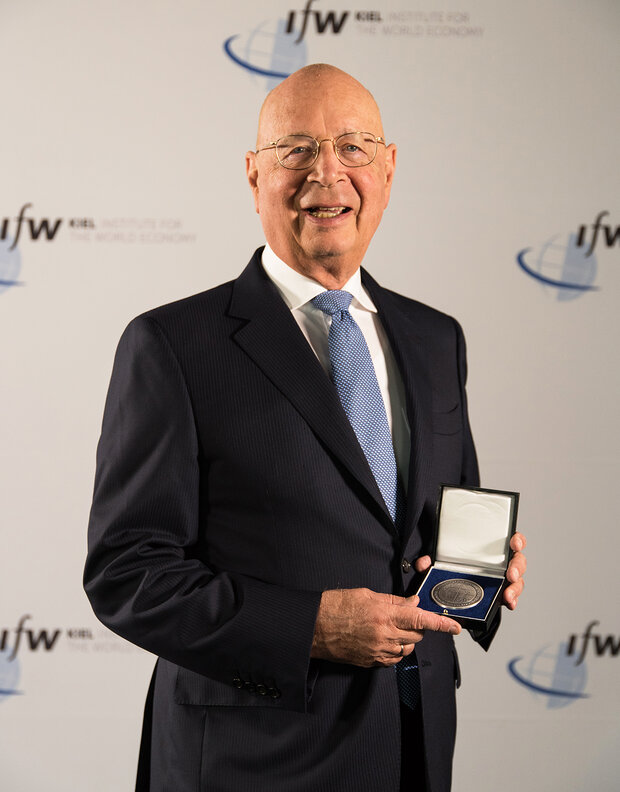
(c) IfW Kiel
Klaus Martin Schwab was born on March 30, 1938, in Ravensburg, Germany, where his father was managing director of a subsidiary of Zurich-based engineering firm Escher Wyss. After graduating from high school in 1957, he studied mechanical engineering at the Swiss Federal Institute of Technology (ETH) in Zurich. He completed his degree in 1962 and in 1966 received his Ph.D. (Dr. Sc. Tech.). Meanwhile, he was also studying economics at the University of Fribourg, where he received a doctorate in 1967. That same year, he earned an MPA in Public Administration from the John F. Kennedy School of Government at Harvard University.
While completing his studies, Schwab worked from 1963 to 1966 as personal assistant to the Managing Director of the German Machine Building Association (VDMA). From 1967 to 1970, he served on the management board of Swiss engineering firm Sulzer, Escher, Wyss AG, in Zurich.
In 1971, he laid the foundation for what is today known as the World Economic Forum by founding the European Management Forum, with the aim of introducing European companies to American management practices. Schwab also used the annual meeting in Davos to promote his multi-stakeholder approach among senior executives. He believed that in order to run a company successfully over the long term, managers should not only take into account the interests of investors, clients, and customers, but also those of employees as well as broader societal concerns.
Political leaders were invited to Davos for the first time in 1974. In response to the collapse of the fixed exchange rates system and war in the Middle East, Schwab sought to extend the Forum's management focus to include economic and social issues. In 1979, Schwab published the first Global Competitiveness Report, a ranking of competitiveness by country, thereby opening up the forum still further to scholarly discussion. Schwab has gradually transformed the gathering into a forum for dialogue between policymakers, business, and academia. In 1987, the European Management Forum was renamed the World Economic Forum.
For Schwab, key milestones of the subsequent years include the Davos Declaration of 1988, signed by Greece and Turkey, which helped prevent a military conflict between the two countries; the first ministerial-level meeting between North and South Korea, which took place in 1989 in Davos; the meeting between East German Prime Minister Hans Modrow and the Chancellor of the Federal Republic of Germany, Helmut Kohl, in the same year in which they began talks about German reunification, as well as the meeting in 1992 between South Africa’s President Willem de Klerk, Nelson Mandela, and Zululand leader Mangosuthu Buthelezi, which contributed to the political stabilization of South Africa.
Today, the annual meeting in Davos is an internationally recognized gathering of leading politicians, senior executives, and major figures from academia, with around 3,000 participants. It attracts huge media attention. Critics see the meeting as a gathering of global elites whose primary concern lies in pursuing their own interests and profits. Advocates argue that global problems, such as climate change, migration, and inequality, can only be resolved through dialogue between those in positions of influence. Thanks to its high-profile participants and informal structure, Davos offers opportunities not found in more official contexts.
Schwab has been Professor of Business Policy at the University of Geneva since 1972, and honorary professor since 2003. He also holds honorary professorships at the Foreign Affairs University in Beijing and at Ben Gurion University in Negev, Israel. In the 1990s, Schwab worked on behalf of the United Nations and advised various UN bodies on sustainable development issues. Together with his wife Hilde, he founded the non-profit Schwab Foundation for Social Entrepreneurship in 1998, the Forum of Young Global Leaders in 2004, and the Global Shapers Community in 2011. He has been awarded numerous honorary doctorates, is a member of various academic communities and advisory boards, and sits on the boards of international companies.
Klaus Martin Schwab is married and has two children.