

Pierre-Olivier Gourinchas to receive 2026 Bernhard Harms Prize
Kiel Institute honours leading international economist and former Chief Economist of the International Monetary Fund (IMF) Pierre-Olivier Gourinchas for groundbreaking research on global imbalances, international capital flows, and the international monetary system. Gourinchas, Professor of Economics at the University of California, Berkeley, will receive the 2026 Bernhard Harms Prize for research that has transformed our understanding of global adjustment and financial stability. His work is particularly relevant amid renewed debates over trade imbalances, US fiscal policy, financial fragmentation, and the future of the dollar.
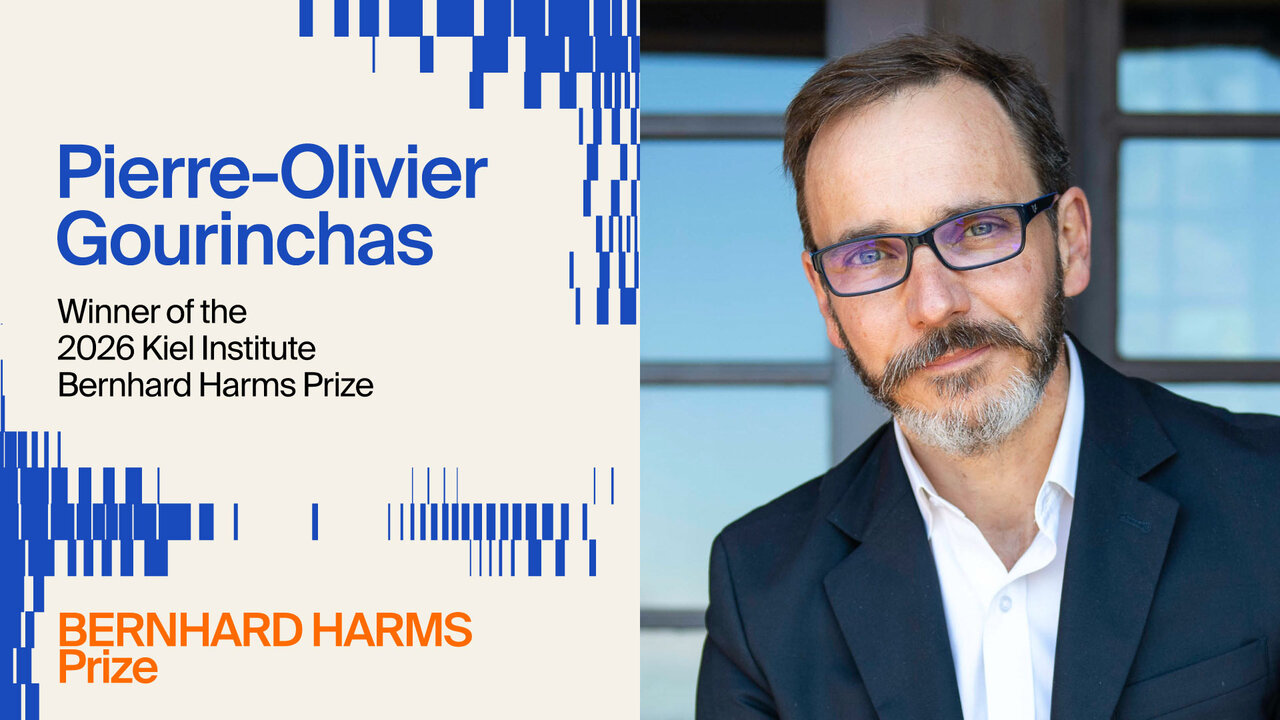
“Pierre-Olivier Gourinchas has shown us that to understand the global economy, we need to look beyond trade balances and consider countries’ assets and liabilities abroad,” says Moritz Schularick, President of the Kiel Institute. “His work on international balance sheets, valuation effects, and capital flows has changed the way economists think about global adjustment and financial crises. And his insights into the special role of the US dollar have become highly relevant as questions about global imbalances and the future of the international monetary system move to the center of economic policy.”
Gourinchas' work shifted the field's perspective in many domains, in particular on capital flows, exchange rates, and global imbalances. He showed that the United States acts as a global financial intermediary, issuing safe dollar liabilities cheaply while investing in riskier assets abroad. This "exorbitant privilege" helps explain persistent US deficits, but also why the United States absorbs losses in crises, effectively insuring the rest of the world. The broader lesson is that global adjustment works not just through trade flows but also through shifts in the value of assets held abroad. These insights are particularly relevant amid growing trade tensions, concerns over US fiscal sustainability, and debates about the future role of the dollar. Europe’s substantial holdings of US assets further underline the importance of understanding international financial positions and capital flows.
“Few economists have mapped such a wide intellectual terrain; fewer still have brought these insights so directly to policy,” Schularick says. “Gourinchas combines fundamental research with an exceptional understanding of the challenges facing the global economy, making him a particularly fitting recipient of the Bernhard Harms Prize.”
Gourinchas recently returned to UC Berkeley, after serving for four years as Chief Economist of the International Monetary Fund (IMF, 2022–2026). He is now the S.K. and Angela Chan Professor in the Department of Economics at Berkeley. Born and raised in France, he studied at École Polytechnique before receiving his PhD from MIT in 1996. He taught at Stanford and Princeton, before joining Berkeley in 2003. Gourinchas is a Vice President of the Centre for Economic Policy Research (CEPR) and a Research Associate at the National Bureau of Economic Research (NBER). He received numerous distinctions, including the Bernácer Prize in 2007 and the Prix du Meilleur Jeune Économiste in 2008.
About the Bernhard Harms Prize
Since 1964, the Kiel Institute’s Bernhard Harms Prize has been awarded to distinguished scholars for their outstanding research in international economics as well as for exceptional efforts in advancing global economic relations. The prize will be presented to Gourinchas during the Kiel-CEPR Conference on Geoeconomics, taking place at the German Federal Foreign Office in Berlin on November 3–4, 2026. The prize is endowed with 10,000 euros and is named after Bernhard Harms, who founded the Kiel Institute in 1914.
Previous Bernhard Harms Prize laureates include Abhijit Banerjee, Carmen Reinhart, Lord Nicholas Stern and Gita Gopinath.