

Ukraine Support Tracker: Europe leads on aid – US weapons remain key
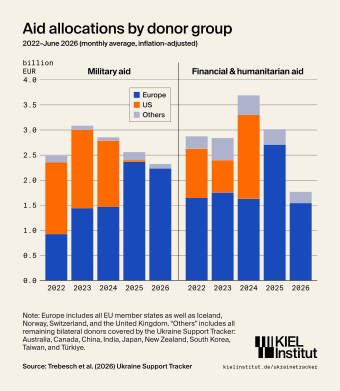
Europe significantly increased its aid allocations to Ukraine in May and June 2026. The main driver was the newly introduced Ukraine Support Loan, through which European institutions allocated nearly EUR 11 billion over the two months. Overall, however, financial and humanitarian aid remained well below last year's level. At the same time, Europe continued to rely heavily on weapons from the United States for its military aid. These are the findings of the latest update of the Ukraine Support Tracker, which covers aid allocations through June 2026.
Of the nearly EUR 11 billion allocated by European institutions over the past two months, EUR 4.3 billion was allocated to military aid and EUR 6.7 billion to financial and humanitarian aid. Most of these allocations were made through the newly introduced Ukraine Support Loan. This EUR 90 billion EU loan is designed to support Ukraine’s budgetary and defense needs in 2026 and 2027.
Beyond the Ukraine Support Loan, European donors also accounted for the majority of newly allocated aid. Germany allocated EUR 700 million in military aid, followed by Denmark with EUR 600 million and the Netherlands with EUR 500 million. In financial and humanitarian aid, the United Kingdom allocated the largest amount among bilateral donors, at around EUR 1.5 billion, followed by Sweden with EUR 360 million and Norway with EUR 140 million.
Financial and humanitarian aid remains below last year’s level
While military aid allocations in the first half of 2026 almost reached last year's level, financial and humanitarian aid remained well below it. On a monthly average basis, financial and humanitarian aid was 41 percent lower than in 2025.
“The rapid launch of the Ukraine Support Loan sends a positive signal to Ukraine,” says Taro Nishikawa, Project Lead of the Ukraine Support Tracker. “Of the EUR 16.7 billion in budget support planned for 2026, half will be allocated as Macro-Financial Assistance, while the other half will be allocated through the Ukraine Facility as agreed reform steps are completed. Maintaining progress on these steps will therefore be important to ensure that the full amount is allocated as planned.”
US weapons underpin Europe's military support
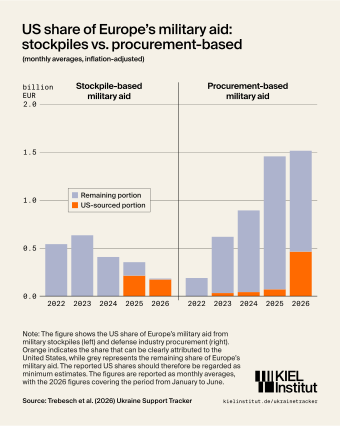
Europe remains the largest donor of military aid, while US weapons continue to play an important role in sustaining European support for Ukraine. In the first half of 2026, the US share of Europe’s military aid increased both in procurement from US defense companies and in deliveries from existing US military stockpiles, signaling Kyiv’s growing request for specific US-made defense systems.
From January to June 2026, European donors procured military aid worth at least EUR 3 billion from US defense companies. This corresponds to around 30 percent of Europe’s military aid provided through defense industry procurement. US stockpiles played a particularly important role under the NATO PURL initiative, accounting for more than 90 percent of the military aid provided through the mechanism.
“Europe continues to depend on the access to US weapons systems to sustain its military support for Ukraine,” says Federico Mellace, Lead Analyst of the Ukraine Support Tracker. “The United States remains a key supplier of systems such as Patriot, for which Europe has only limited alternatives at the moment. In the longer term, the key question will be whether Europe can develop and produce reliable substitutes to key US defense systems to gradually reduce this dependence.”
About the Ukraine Support Tracker
The Ukraine Support Tracker tracks and quantifies military, financial, and humanitarian assistance pledged to Ukraine since January 24, 2022. Included are 41 countries, specifically the EU member states, the other members of the G7, Australia, South Korea, Turkey, Norway, New Zealand, Switzerland, Turkey, China, Taiwan, India, and Iceland. It includes pledges made by the governments of these countries to the Ukrainian government; aid pledged by the EU Commission and the European Investment Bank is listed separately; private donations or those from international organizations such as the IMF are not included in the main database. Nor does it include aid to Ukraine's neighbors, such as Moldova, or to other countries, such as for the reception of refugees.
Data sources include official government announcements and international media reports. Aid in kind, such as medical supplies, food, or military equipment, is estimated using market prices or information from previous relief operations. In cases of doubt, the higher available value is used. The Ukraine Support Tracker is constantly being expanded, corrected and improved. Feedback and comments on our methodology paper and dataset are very welcome. You can reach us at ukrainetracker@ifw-kiel.de.
More information and all detailed data can be found on the Ukraine Support Tracker webpage.