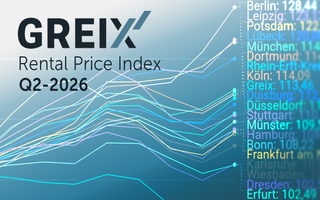
GREIX Rental Price Index Q3/25: Rents rise only slightly
Rents in German cities are now rising at the same rate as the general cost of living. Meanwhile, the supply of apartments is low, and they are being relet at nearly record speed. This is reflected in the latest update of the GREIX Rental Price Index, published by the Kiel Institute for the World Economy. The index analyzes asking rents for apartments based on data from the “VALUE Marktdatenbank” across 37 German cities and regions.
Discover the GREIX Rental Price Index
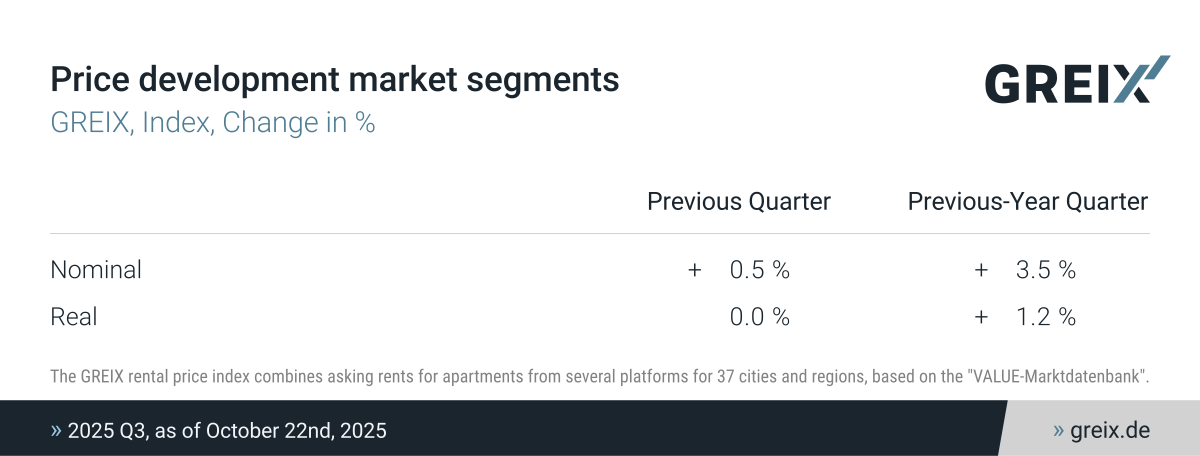
Compared to the previous quarter (Q3 vs. Q2 2025) asking rents for apartments rose by 0,5 percent. However, adjusted for inflation, they stagnated. Compared to the same quarter last year, rents increased by 3,5 percent in nominal terms and by 1,2 percent when adjusted for inflation, marking the lowest annual increase since late 2021.
"Price dynamics in the rental market have cooled significantly following the sharp increases of recent years," said Jonas Zdrzalek, the head of the GREIX project at the Kiel Institute. "On average, rents are now rising at the same rate as inflation. At the same time, apartments are being rented more quickly, highlighting the continued high demand for housing."
Uneven development in major cities
In a quarter-on-quarter comparison, the eight largest German cities exhibited varying developments. Rents rose most sharply in Leipzig (1.1 percent) and Düsseldorf (0.7 percent). Munich, Frankfurt am Main, and Cologne saw a 0.5 percent increase, while Stuttgart experienced a 0.3 percent increase. Meanwhile, there were slight declines in Hamburg (-0.2 percent) and Berlin (-0.3 percent).
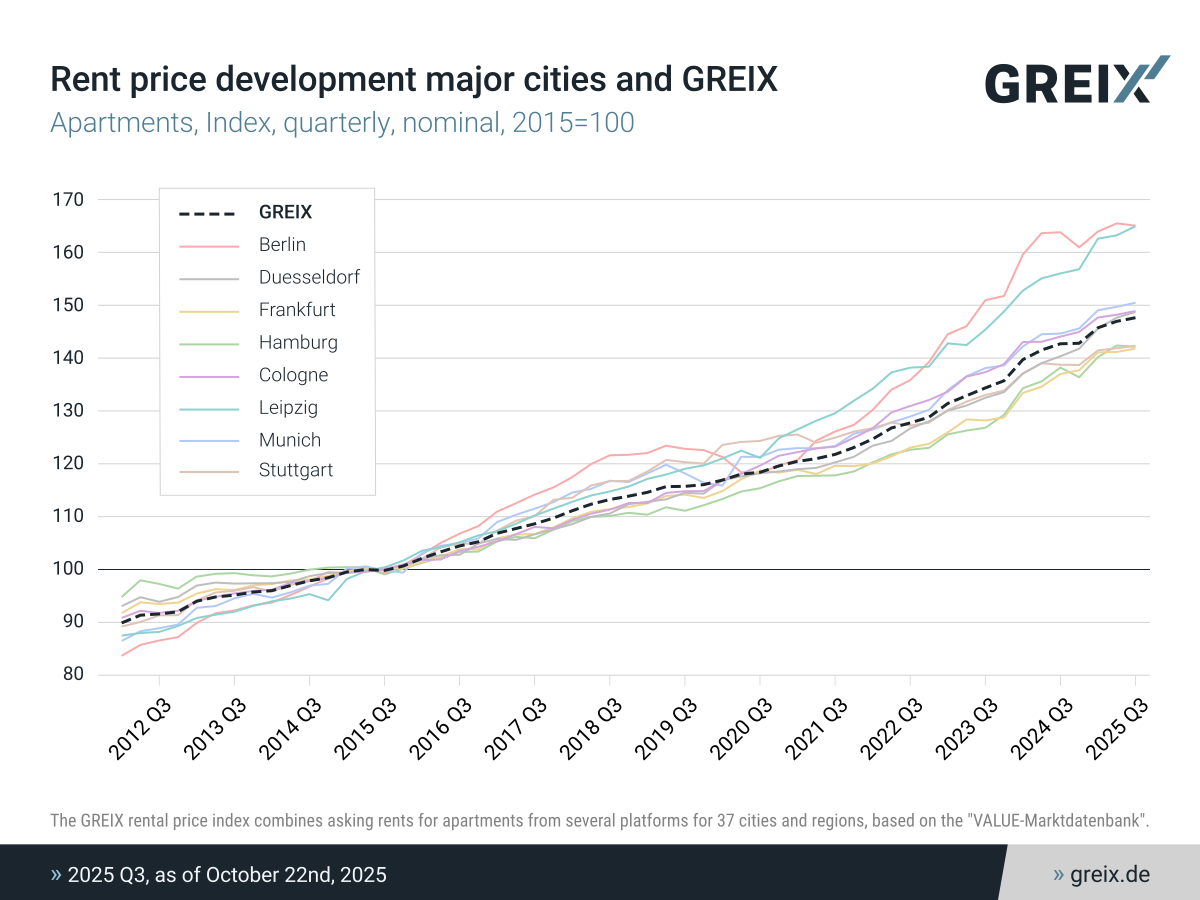
Rental prices vary greatly. Munich had the highest average rent in the third quarter, at € 22.96 per square meter, followed by Frankfurt am Main, at € 17.55. Stuttgart (€ 16.11), Berlin (€ 15.82), Hamburg (€ 15.62), and Cologne (€ 15.21) were in the middle of the pack, while Düsseldorf (€ 14.40) and Leipzig (€ 10.14) were at the lower end. The weighted average price per square meter across all cities was € 14.16.
Notable changes in smaller towns
Potsdam (+3.4 percent) and Erfurt (+3.2 percent) experienced notable rent increases. North Rhine-Westphalia also saw significant hikes, with Hamm (+1.8 percent), Mönchengladbach, and Wuppertal (+1.6 percent) all rising well above average. Meanwhile, declines were recorded in Bielefeld (-1.3 percent), Bocholt (-0.6 percent), and Münster (-0.4 percent).
At € 14.48/m² in Potsdam, € 14.27/m² in Augsburg, and € 13.74/m² in Münster, some smaller cities are on a par with major cities. The lowest rents are in Chemnitz (€ 6.15), Gelsenkirchen (€ 7.42), and Duisburg (€ 8.21).
Time-on-the-market almost at an all-time low—supply shortage high
Compared with the previous quarter, the number of rental properties on offer rose by 3.8 percent, but it was low in the long-term comparison, at around 15 percent less than in 2015. In Hamburg and Leipzig, the number of listings has nearly halved since then.
The average listing duration fell to just over 24 days in the third quarter, which is almost one day less than the previous quarter and four days less than the same quarter last year.
From a historical perspective, this figure is extremely low. When data collection began around ten years ago, the average listing duration was 34 days. However, it briefly fell to an even lower level than it is now.
"These figures show that the supply shortage continues despite moderate price increases. Even with only moderate rent increases, the market for apartment seekers is extremely tight, especially in major cities," says Zdrzalek. "Without a noticeable increase in new construction, the situation is unlikely to improve."
Read short report now:

GREIX Rental Price Index:
The GREIX Rental Price Index provides a detailed analysis of rental price trends in 20 cities and regions. Price changes can be viewed in interactive graphs for various time periods and based values (index and price per square meter). Discover now: www.kielinstitut.de/greix-mietpreisindex
Methodological note:
The price development of the GREIX Rental Price Index is calculated as an index. This allows statistical methods (hedonic method) to be used to mitigate price distortions that often arise when using average price per square meter. For instance, if a high number of apartments in a prime location or in an extraordinary condition are sold, this can inflate average prices per square meter. However, such fluctuations may not reflect a general increase in real estate values. Using hedonic regression methods, specific property characteristics do not cause upward or downward distortions in the price trend.