

EU tariffs against China redirect trade of EVs worth almost USD 4 billion
Should the EU impose a 20 percent tariff on imports of Chinese electric cars, as speculated, it would have a noticeable impact on bilateral trade and production in Europe. The volume of imported electric cars from China would fall by 25 percent. Converted to the almost 500,000 vehicles imported in 2023, this corresponds to an estimated 125,000 units worth almost 4 billion US dollars. The decline would largely be offset by an increase in production within the EU and a lower volume of EV exports, which would likely mean noticeably higher prices for end consumers. This is shown by simulations by the Kiel Institute.
"In view of China's subsidy practices, it is right that the EU Commission reserves the right to impose tariffs in response. It is important that the Commission's authority is not undermined by individual member states due to particular interests, because a divided EU is a weak EU," says Moritz Schularick, President of the Kiel Institute.
Simulations by the Kiel Institute show that EU tariffs of 20 percent on Chinese EVs would result in noticeable trade shifts. EVs worth around USD 3.8 billion would then no longer be imported into the EU from China, which could also affect German car manufacturers producing in China. Sales of domestically produced EVs in the EU are likely to increase by almost the same amount, namely by USD 3.3 billion. Only part of this growth will be covered by increased production within the EU, however. Vehicles worth around USD 1 billion are likely to be shifted from export to domestic sales. A reaction from China is not included in the calculations, but is to be expected given the scale of the effects.
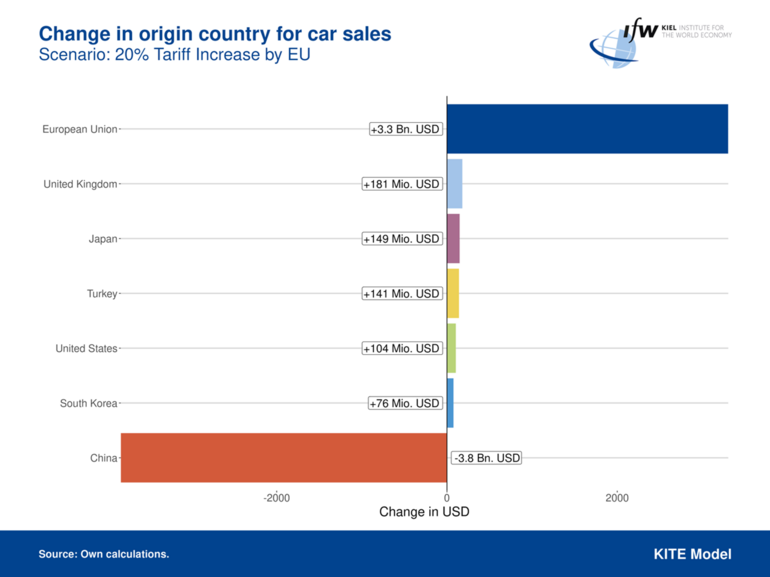
"For consumers, this is likely to result in higher prices for electric vehicles because production within the EU is significantly more expensive than in China due to higher energy and material prices and, above all, significantly higher labor costs," says Julian Hinz, a trade researcher at the Kiel Institute.
"However, it is by no means a foregone conclusion that European car manufacturers will fill the gap, Chinese manufacturers such as BYD could also meet local demand with new plants in Europe."
If China exports fewer EVs, the demand for inputs for production from the EU will also fall. EU exports to China in the "Motor vehicles and parts" segment, for example, are likely to fall by 0.6 percent or USD 237 million as a result of the tariffs. Overall, EU exports to China would fall by over USD 600 million without China having responded with its own tariff measures.
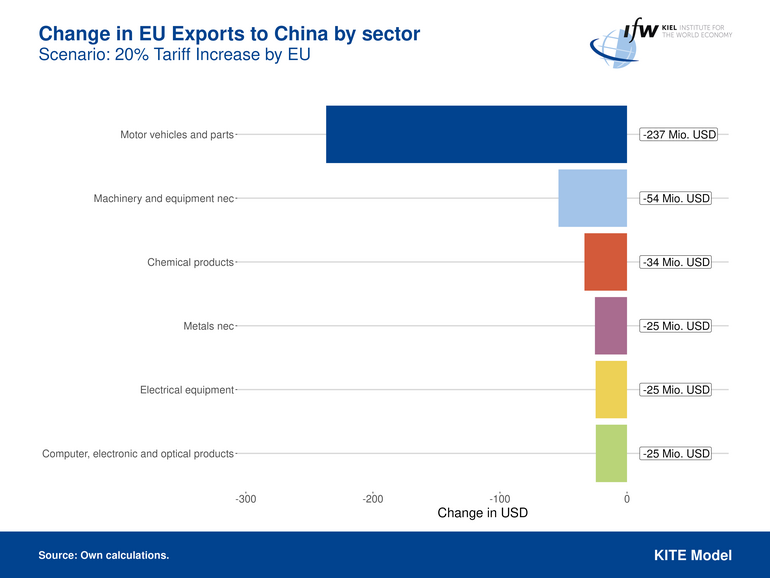
The simulations are based on the Kiel Institutes KITE model. The results show the medium- to long-term trade effects that arise permanently once new trade structures and supply chains have been established. Short-term distortions are not taken into account in the model.