

Recovery under structural stress – fiscal policy on slippery ground
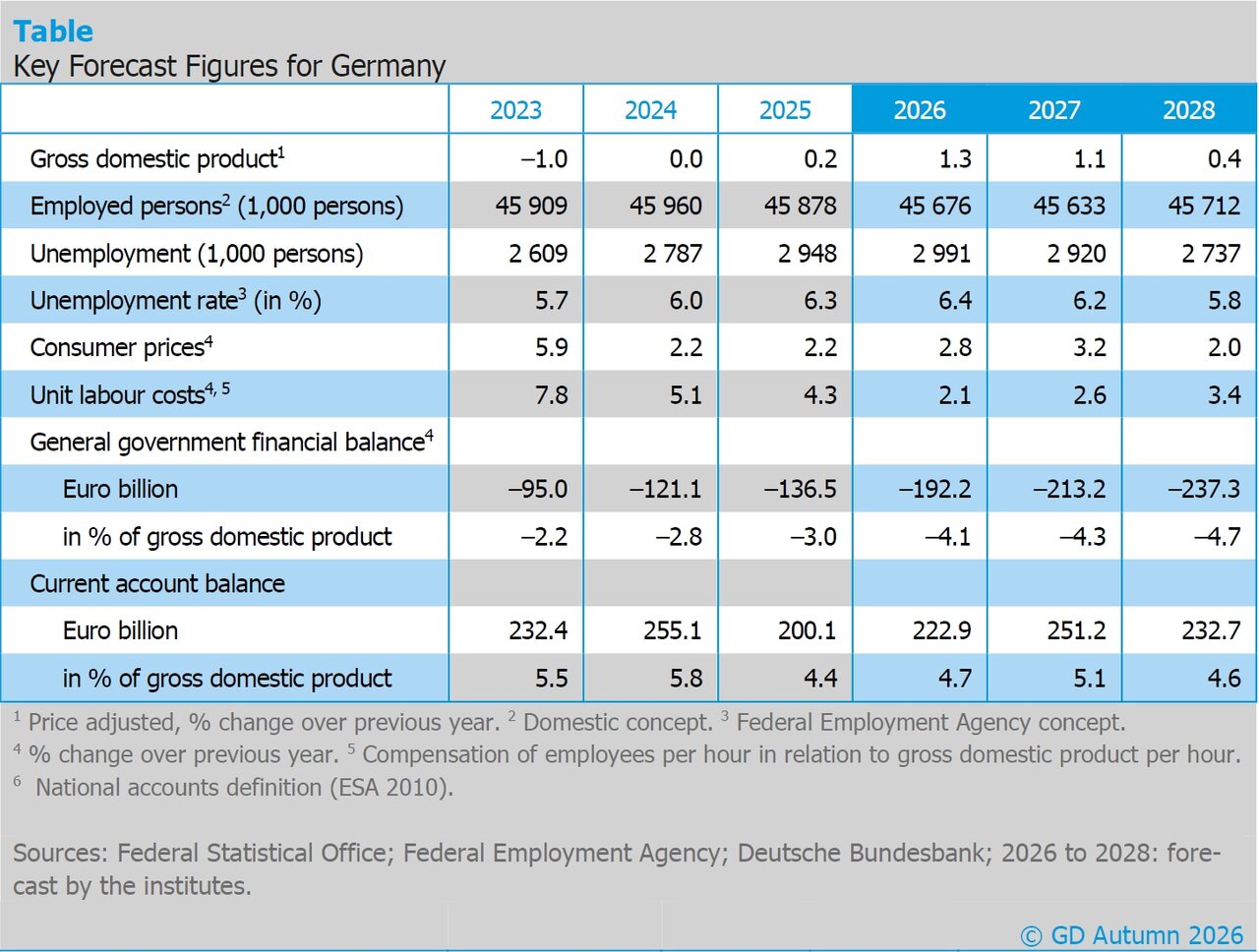
The German economy has been recovering since the end of 2025. This recovery, although stronger than expected in spring, remains modest. The leading economic research institutes expect GDP growth of 1.3% for the current year and 1.1% and 0.4% for the following two years, respectively. Compared with the spring forecast, the outlook for 2026 has been revised upward by 0.7 and that for 2027 by 0.2 percentage points.
“The economy has developed more robustly than expected. However, the recovery rests on a narrow foundation, as high energy prices and structural problems continue to weigh on economic activity,” says Oliver Holtemöller, Head of Macroeconomic Forecasting at the Halle Institute for Economic Research (IWH). In the current quarter, low water levels are also temporarily dampening economic activity. The government deficit continues to increase, leading to a growing need for fiscal consolidation.
The German economy performed significantly better in the first half of 2026 than had been expected in spring. In particular, exports and value added in the manufacturing sector increased markedly. Growth was supported by a robust global economy and the worldwide AI boom, while competitors in the Gulf region suffered significant production disruptions as a result of the Iran war. Government consumption also expanded markedly. By contrast, business investment and private consumption remained weak. Although the energy price shock associated with the Iran war has weighed on the German economy, the higher prices for motor fuels and heating oil have so far had little spillover effect on broader consumer prices.
The recovery temporarily slowed in the third quarter. While sentiment indicators continue to improve, the latest hard economic data have come in weaker. In particular, the low water levels that have persisted since mid-July are hampering production in the chemical industry. At the same time, higher energy prices are weighing on purchasing power and, consequently, on private consumption. Real GDP is estimated to have increased by only 0.1% in the third quarter. As water levels return to normal, however, the production constraints are expected to ease from the fourth quarter onward. The recovery will then be supported by robust foreign demand and rising public expenditure on defense and infrastructure.
The institutes expect the recovery to continue in 2027, driven primarily by domestic demand. Private consumption is projected to increase moderately in line with real disposable incomes, while residential construction investment is expected to gradually recover. Overall, however, private investment activity is likely to remain subdued. In 2028, economic expansion is expected to lose momentum. The recovery will increasingly be constrained by structural factors: the labour force is shrinking due to demographic change, and potential growth continues to decline. As a result, even relatively low growth rates will in the future be sufficient to fully utilise the economy’s productive capacity.
Overall, the institutes forecast real GDP growth of 1.3% in 2026, 1.1% in 2027, and 0.4% in 2028. Compared with the spring forecast, the projection for 2026 has been revised upward by 0.7 percentage points and that for 2027 by 0.2 percentage points. Inflation is expected to increase from 2.8% this year to 3.2% in 2027 before easing to 2.0% in 2028. The labour market is likely to respond only with a lag: employment is expected to decline further for the time being, while the unemployment rate falls from 6.4% in 2026 to 6.2% in 2027 and 5.8% in 2028.
The institutes see a growing need for action in fiscal policy. The general government budget deficit is projected to increase from 4.1% of GDP in the current year to 4.7% in 2028. Growth in net primary expenditure is expected to exceed significantly the path envisaged under the European fiscal framework. Even if the reformed national debt brake is complied with, the debt-to-GDP ratio is projected to continue rising over the medium term; moreover, interest expenditure is set to increase substantially. As a result, the need for fiscal consolidation is growing.
Full-length version of the report (in German)
Joint Economic Forecast Project Group: Aufschwung mit Strukturproblemen – Finanzpolitik auf Abwegen. Autumn 2026. Halle (Saale) 2026.
The full-length version of the report will be available on 24 September 2026 at 10:00 a.m. at www.gemeinschaftsdiagnose.de/category/gutachten/.
About the Joint Economic Forecast
The Joint Economic Forecast is published twice a year on behalf of the German Federal Ministry for Economic Affairs and Energy. The following institutes participated in the autumn report 2026:
- German Institute for Economic Research (DIW Berlin)
- ifo Institute - Leibniz Institute for Economic Research at the University of Munich in cooperation with Austrian Institute of Economic Research (WIFO) Vienna
- Kiel Institute for the World Economy
- Halle Institute for Economic Research (IWH) – Member of the Leibniz Association
- RWI – Leibniz Institute for Economic Research