

Autumn Forecast Kiel Institute: German economy overcomes recession—structural deficits remain
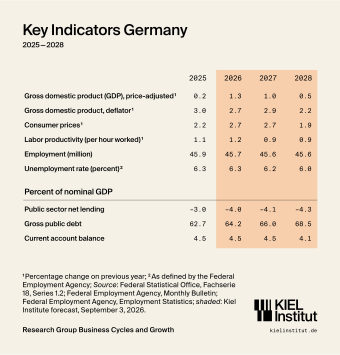
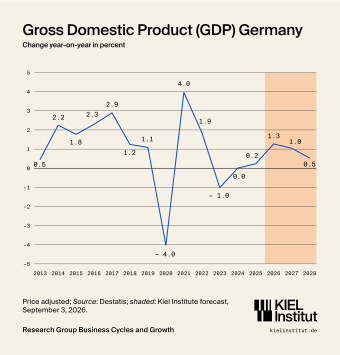
The German economy is recovering step by step: economic activity has picked up noticeably and despite geopolitical headwinds, companies are once again looking somewhat more confidently into the future. This is the finding of the Kiel Institute's latest autumn forecast. The forecast for gross domestic product in the current year has been raised significantly, by 0.5 percentage points, to 1.3 percent. For 2027, 1.0 percent is still expected, and for 2028 only 0.5 percent. The economy has passed its trough – but the recovery remains fragile.
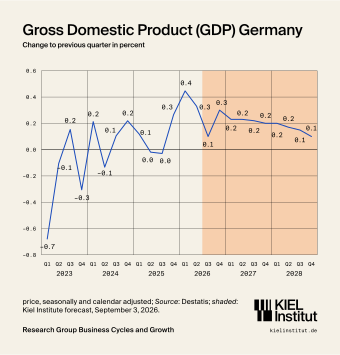
The German economy is growing only tentatively this autumn. Around 0.3 percentage points of this year's increase in gross domestic product (GDP) are attributable to the higher number of working days. For the third quarter, a rise of just 0.1 percent is expected, because the prolonged low water on the Rhine is dampening production by an estimated 0.2 percent. Towards the end of the year, economic output should pick up more strongly again. Further setbacks still threaten from the consequences of the Iran war. Additional expansionary impulses from fiscal policy, which are boosting economic output this year, will fade in the coming years. The recovery is being carried by foreign trade, while private consumption remains weak.
Inflation remains high, private consumption stays subdued
While the higher oil and gas prices resulting from the Iran war reach consumers directly at the filling station, the higher energy costs in other areas are being passed on to consumers only gradually. The inflation rate will therefore remain high at 2.7 percent both this year and next. The associated loss of purchasing power for private households is dampening private consumption. Only in 2028, as energy prices fall again, is inflation likely to decline markedly to 1.9 percent, allowing private consumption to somewhat pick up.
“Private investment remains subdued – the special fund for infrastructure and the rise in government defense spending are certainly providing a boost. But these fiscal policy impulses will expire in the following years, while social security contributions rise and geopolitical risks remain high,” explains Moritz Schularick, President of the Kiel Institute. “That is why reforms to strengthen Germany as a business location are so important.”
Read the economic forecast now:
Exports rise and support the recovery
The recovery is being driven above all by foreign trade: after three years of decline, exports are expected to rise by 3.8 percent in 2026, by 2.4 percent in 2027 and by 1.0 percent in 2028. “Given the massive losses of market share in recent years, however, this is hardly more than a drop in the ocean, and some sectors are currently benefiting from war-related supply difficulties among their Asian competitors,” says Stefan Kooths, Head of Forecasting at the Kiel Institute. “The continuing decline in competitiveness reflects Germany's weaknesses as a business location and is likely to lead to further losses of global market share.” While German goods exports in the second quarter were roughly at their 2019 level, global merchandise trade rose by around 18 percent over the same period.
Government debt rises – labor market recovers only hesitantly
Public finances will also deteriorate significantly. The budget deficit will rise from 3.0 percent of gross domestic product in 2025 to 4.3 percent in 2028, the government expenditure ratio from 50.2 to 52 percent, and the debt level from 62.7 to around 68.5 percent. Resorting to higher deficits can only temporarily postpone the need for consolidation measures.
On the labor market, the recovery is increasingly being overshadowed by demographic change. The number of people in the labor force continues to fall, although the decline is being slowed by the economic upturn as unemployment is reduced. The unemployment rate will remain at 6.3 percent this year, before falling gradually to 6.2 percent and then 6.0 percent in the following years.
Energy prices remain a key risk
Energy prices are seen as a key risk, given the uncertain situation in the Persian Gulf and low gas reserves in Germany: German gas storage facilities were recently only just over half full, and around 62 percent across Europe, while shipping through the Strait of Hormuz remains significantly restricted. A gas shortage would only threaten in the event of a very cold winter combined with supply interruptions, but price volatility is likely to remain high – with corresponding upside and downside risks for the economy.
AI boom supports the recovery of the global economy
Despite higher energy prices and increased geopolitical risks, global economic activity slowed only slightly in spring 2026. Sharp production losses remained confined to the countries of the Persian Gulf; elsewhere, gross domestic product mostly continued to rise markedly. Positive impulses still come from the boom in AI technology, which is stimulating trade and investment and is driving economic activity in Asia in particular.