
Stable prices, halved sales numbers: why a price index alone does not capture the market
The rise in interest rates since the beginning of 2022 has affected the market for apartments very unevenly. For high-quality apartments, the number of sales almost halved, while prices declined by only around 9 percent. In the lowest quality segment, the opposite was true. There, prices fell considerably more, while the number of sales declined far less. The picture from the listings is consistent with this: in the high-quality segment, the share of providers lowering their price expectations over the course of a marketing period increased the least, while at the same time the completion rate there declined the most. Anyone looking only at price indices therefore misses the decisive part of the adjustment, namely that a market can become illiquid without prices indicating it.
These insights are based on the first edition of GREIX Insight, a new series by the Kiel Institute for the World Economy that examines individual developments in the German residential real estate market in greater depth. For this analysis, the authors combine notarized transaction data from the GREIX on the one hand with listing data from the VALUE Marktdatenbank on the other, evaluating how the adjustment to the interest rate turnaround is distributed across the quality segments of the market. All data is available free of charge in the GREIX Data Hub.
Across the market as a whole, the adjustment took place primarily through volumes. Between the beginning of 2022 and mid-2023, the mortgage rate with a fixed-interest period of more than ten years rose from just under 1.5 to 3.9 percent. Market activity responded immediately and considerably. Between the fourth quarter of 2021 and the first quarter of 2023, the number of transactions fell by 30 percent. Prices declined by only around 15 percent over the same period. Since 2024, the market has been recovering with interest rates practically unchanged, but remains below the level seen before the interest rate turnaround.
Volumes adjust at the top, prices at the bottom
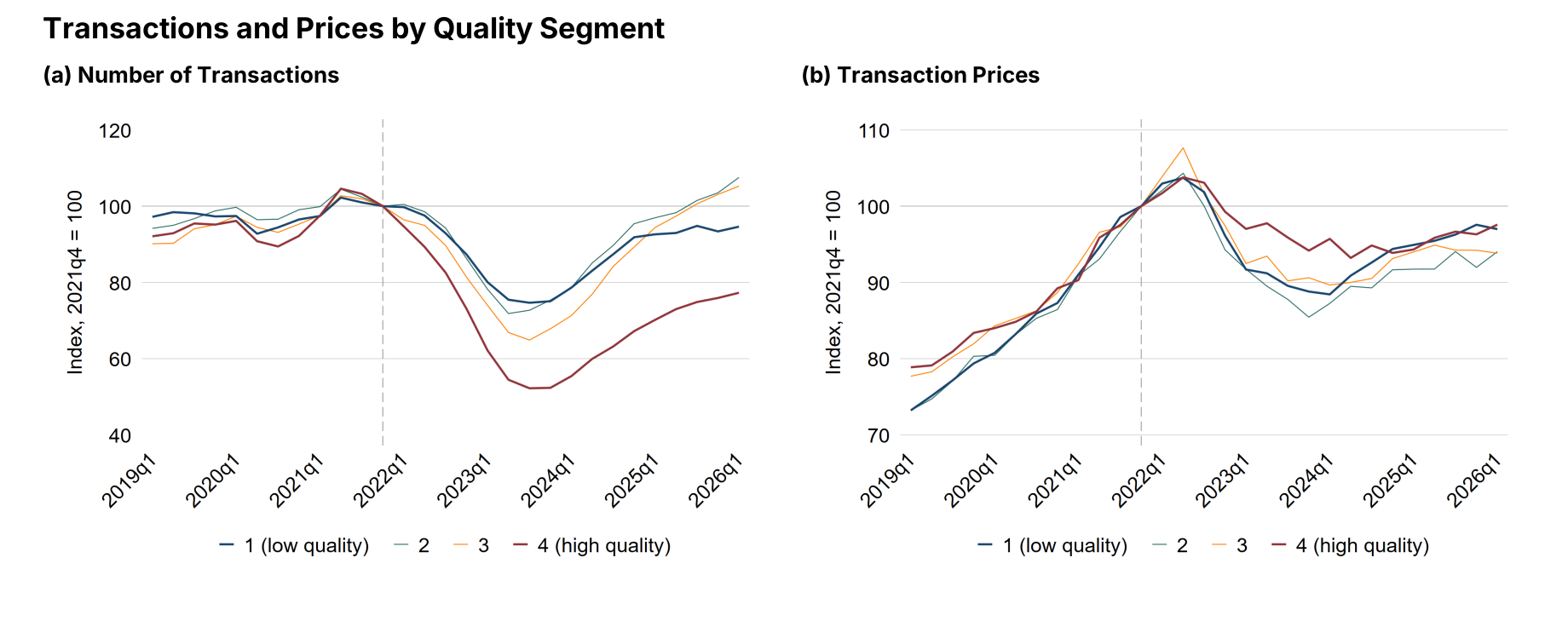
Behind the overall picture lie opposing patterns. The authors assign each transaction to one of four quality segments based on its property and location characteristics. In the highest quality segment, typically newer apartments, the number of sales fell by 48 percent through the end of 2023, compared with only 25 percent in the lowest quality segment. For prices, the ranking is reversed: from their peak in mid-2022 to the market's trough at the end of 2023, high-quality apartments lost only 9 percent, compared with around 15 percent in the rest of the market. Currently, transactions in the highest quality segment are still around 23 percent below the level of end-2021, while in the lowest quality segment they are only around 5 percent below.
The rise in interest rates shifted demand downward, and it affected lower-income households more severely, so the decline is likely to have been stronger in the lower quality segment. However, such a difference in the strength of the decline in demand between quality segments cannot explain the observed development of transactions and prices. A shift in demand moves prices and volumes in the same direction.
It follows as a necessary condition that the supply side differs between the quality segments. The fact that volumes decline particularly sharply and prices particularly little in the high-quality segment is consistent with supply responding more elastically there: someone selling a high-quality apartment may be more able to postpone the sale and wait for better conditions, whereas sales in the lower quality segment do not permit delay.
Less frequent price reductions, shorter marketing periods, fewer completed sales
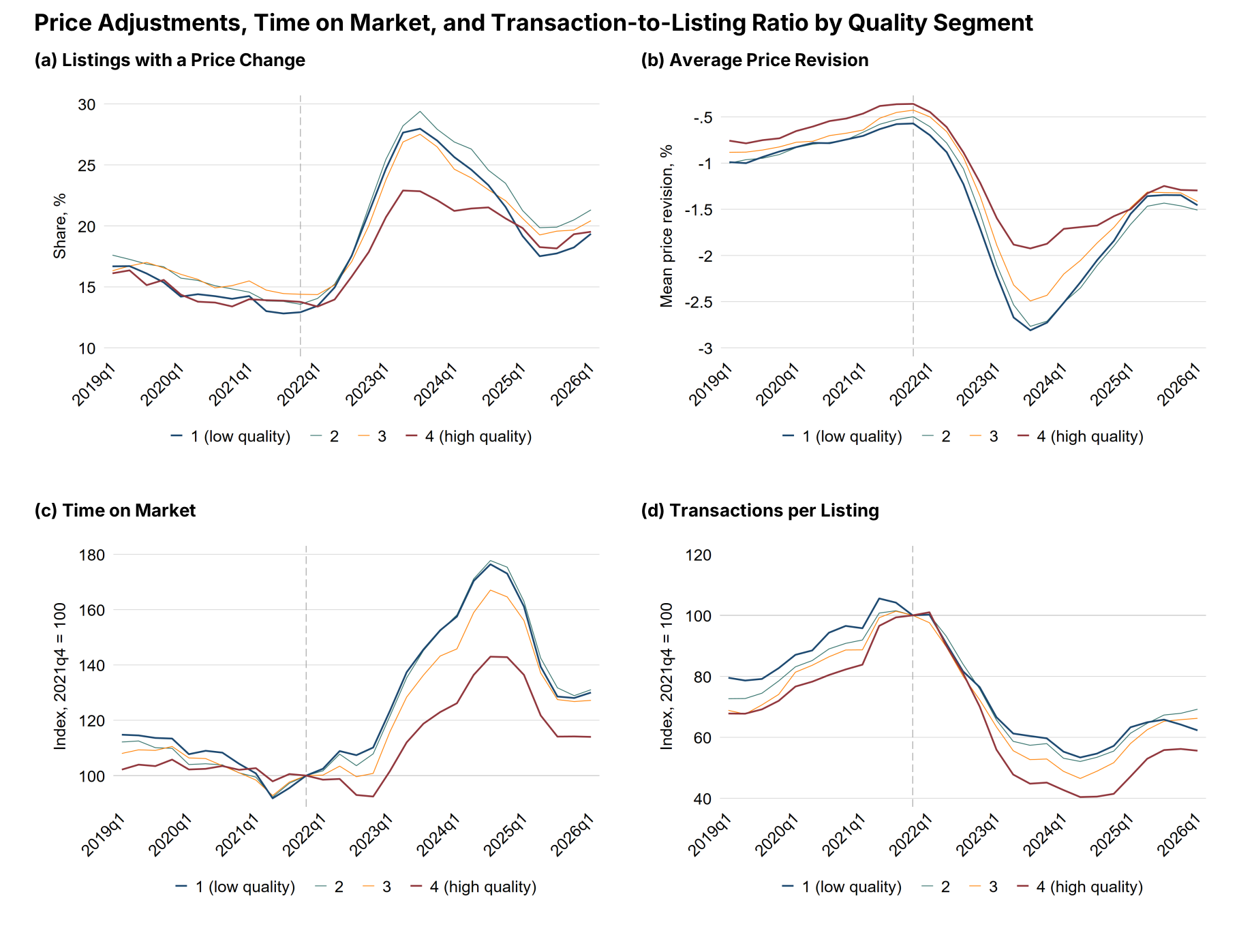
The listing data supports this observation. Before the interest rate turnaround, around 14 percent of providers adjusted their asking price over the course of a marketing period across all segments. By the end of 2023, this share had risen to between 27 and 29 percent in the lower three quartiles, but to only 22 percent in the top quartile. The difference lies not in the size of the reductions but in their frequency.
Notably, the marketing period increased the least in the high-quality segment of all places, whereas the number of sales declined the most there. Up to its peak in the third quarter of 2024, it lengthened by 43 percent in the highest quality segment and by 76 percent in the lowest. If providers hold on to their prices and demand falls, listings should stay on the market longer, not shorter.
This contradiction resolves if listings more frequently end without a sale taking place. This is precisely what the number of transactions per listing shows. It fell by 60 percent in the high-quality segment and by 47 percent in the lower quality segment. The higher the quality, the less frequently a listing appears to result in a completed sale.
"A price index measures only those sales where both sides reached an agreement. If particularly many owners in the high-quality segment abandon the sale rather than accept larger reductions, what remains is a particular selection of sales. The measured price decline of 9 percent therefore describes only part of what has changed there. Anyone seeking to assess the market cannot rely on prices alone and must equally look at the number of transactions, at price adjustments in listings and at the marketing period. These are exactly the indicators we provide in the GREIX," says Jonas Zdrzalek, GREIX Project Lead at the Kiel Institute for the World Economy.
Should demand pick up more strongly again, this yields a testable expectation. In the high-quality segment, the number of sales should rise first, while prices respond comparatively little. Whether the properties held back will actually return to the market remains open: owners may also abandon a postponed sale permanently, rent out the apartment or transfer it within the family.
Note: GREIX Insight is a new publication series that examines individual developments in the German residential real estate market in greater depth. It draws on transaction data from the sales price collections of the local expert committees as well as listing data from the VALUE Marktdatenbank. Further information on data cleaning and methodology is available at www.greix.de.