
Price momentum weakens, real prices fall year-over-year
Prices for residential real estate in Germany rose only moderately in the second quarter of 2026. Apartments and single-family homes became more expensive in nominal terms, while multi-family homes were traded cheaper. Adjusted for inflation, by contrast, all three market segments are down year-over-year: measured in current purchasing power, residential real estate is worth less today than it was a year ago.
These insights are based on the latest update of the GREIX sales price index, a joint project of the local expert committees for property values (Gutachterausschüsse für Grundstückswerte) and the Kiel Institute for the World Economy. The GREIX sales price index is based on notarized transaction data from sales price collections of the local expert committees and tracks price developments in 24 cities and regions. All data is available at greix.de.
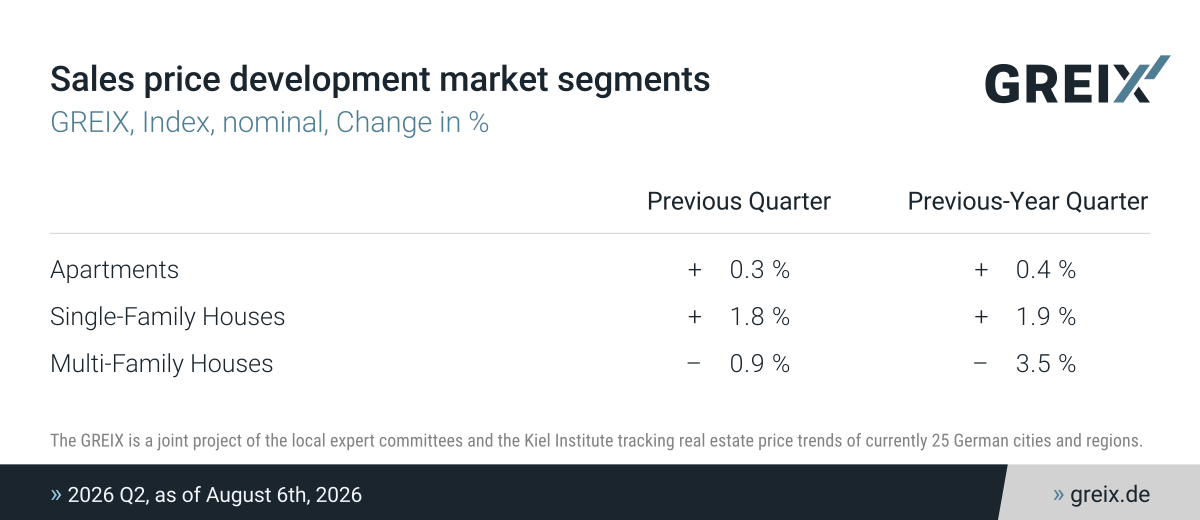
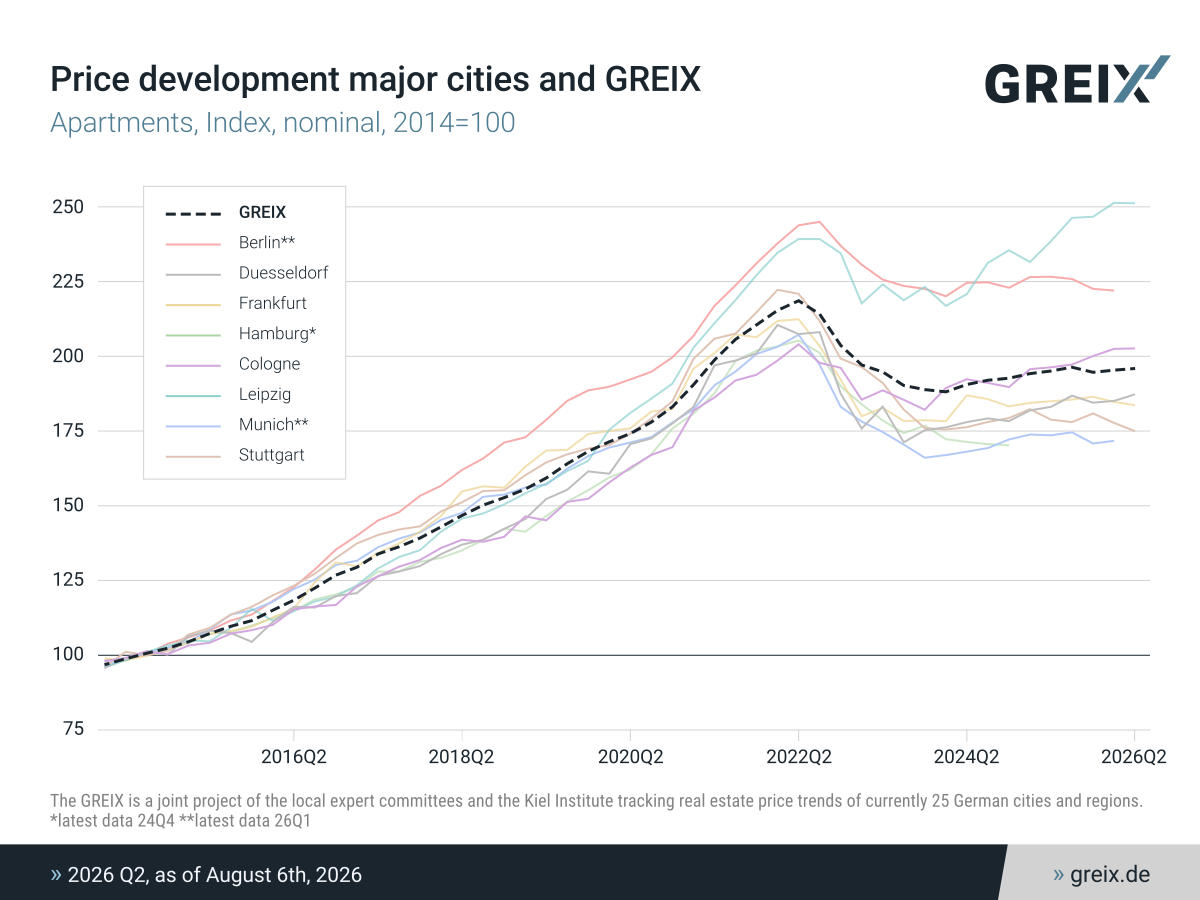
Compared to the previous quarter, nominal prices for apartments rose by 0.3 percent, while single-family homes became 1.8 percent more expensive. Multi-family homes, by contrast, declined by 0.9 percent. In the year-over-year comparison, apartments were up 0.4 percent and single-family homes up 1.9 percent, while multi-family homes were 3.5 percent below the prior-year level.
In real terms, price levels decline year-over-year across all three segments
Adjusted for inflation, that is, measured in current purchasing power, price developments are considerably weaker. Compared to the previous quarter, apartments were down 0.9 percent and multi-family homes down 2.0 percent in real terms, while single-family homes gained 0.6 percent. In the year-over-year comparison, however, all three segments are in negative territory: apartments by 2.1 percent, single-family homes by 0.7 percent and multi-family homes by 5.9 percent.
The difference between the nominal and the real perspective is more than a mere technicality. For apartments and single-family homes, sales prices in euros have continued to rise compared to the previous year, but more slowly than general inflation. Sellers therefore achieve higher prices in nominal terms yet can afford less with that amount than a year ago. For multi-family homes, both effects come together: here prices have already fallen by 3.5 percent in nominal terms, so that the real decline of 5.9 percent is the steepest. Given the low number of transactions in this segment, however, these figures are less conclusive.
"In nominal terms prices are still rising, but the upward momentum has visibly lost steam. What matters is the view on purchasing power: year-over-year, all three market segments are down in real terms. This is consistent with the fact that asking prices in listings are being adjusted downward more frequently again, which in the past has been a reliable indicator of weakening price dynamics," says Jonas Zdrzalek, GREIX Project Lead at the Kiel Institute for the World Economy.
A mixed picture in the largest cities
Current figures for the second quarter of 2026 are available for five of the eight largest cities. For apartments, Düsseldorf (+1.2 percent) and Cologne (+0.1 percent) gained compared to the previous quarter, while Leipzig remained virtually unchanged at -0.1 percent. Declines were recorded in Frankfurt am Main (-0.6 percent) and Stuttgart (-1.6 percent). Data for Berlin, Hamburg and Munich is not yet available.
Other cities: from slight declines to moderate gains
Outside the eight largest cities, too, no uniform trend emerged. In Bonn, apartment prices rose by 2.8 percent compared to the previous quarter, in Münster by 2.1 percent and in Dortmund by 1.9 percent. In Bochum they were 0.5 percent below the previous quarter's level.
More apartment sales, higher transaction volume
The number of transactions has been rising for several quarters. The first quarter of 2026 confirms this trend: 9.3 percent more apartments changed hands than a year earlier. The transaction volume, that is, the sum of all purchases in euros, was also clearly above the prior-year figure at 12.1 percent. For single-family and multi-family homes, by contrast, market activity remained largely unchanged, with both sales numbers and volumes slightly below the previous year.
The still preliminary number of transactions for the second quarter of 2026 suggests that the increase for apartments is continuing, although at a noticeably slower pace than in previous quarters. As individual purchase contracts are recorded with a time lag, the rate of change cannot yet be determined conclusively.
Price adjustments in listings as an early indicator
In addition to transaction data, the GREIX evaluates liquidity indicators derived from listing data of the VALUE Marktdatenbank. One of these indicators is the relative size of the price adjustment of a listing. How far providers move away from their original price expectations over the course of a marketing period points to developments in the coming quarters. Across 45 quarters from 2015 to 2026, the pattern is clear: when price reductions in listings increase compared to the previous year, annual price growth in the following quarter tends to be weaker. Conversely, price dynamics often improve once reductions ease again. This pattern could be observed particularly at turning points in price developments in the past.
Note: The real estate price indices are compiled on the basis of actual transaction data from the sales price collections of the local expert committees and are adjusted for distortions caused by specific property characteristics using the hedonic method. Due to the time lag between the notarized purchase and its recording in the sales price collection, it is possible that individual purchase contracts have not yet been included in the calculation. Further information on data cleaning and methodology is available at www.greix.de.
Read short report now:

Methodological note
The Greix sales price index is based on a hedonic regression method. This method mitigates the price distortions that often arise when using the average price per square meter. For example, if a large number of expensive apartments in a desirable location are sold in a given year, this can inflate the average price per square meter. However, these fluctuations may not reflect an overall increase in real estate values. Hedonic regression methods mitigate the impact of specific property characteristics on price trends.
About the GREIX
- What is the German Real Estate Index (GREIX)?
The German Real Estate Index (GREIX) is a publicly funded research project hosted at the Kiel Institute for the World Economy that aims to increase transparency in the German real estate market. To this end, GREIX regularly publishes updates on the development of sales prices (GREIX sales price index) as well as on the development of asking rents (GREIX rental price index). In addition to these price developments, GREIX publishes special analyses, for example on affordability or on price-determining factors such as location or energy efficiency. - What is the GREIX sales price index?
The GREIX sales price index is a real estate price index for Germany based on the sales price collections of the local expert committees, which contain notarized sales prices. It tracks the price development of individual cities and neighborhoods back to 1960 and is based on more than two million transaction data. The dataset can be used to analyze long-term trends in the real estate markets and to place current developments in a historical context. On greix.de, sales price indices for various market segments in currently 24 cities are freely available. The dataset will gradually be expanded to include additional cities. - What data and methods are used to create the indices?
Data collection is carried out by the local expert committees, which record all property transactions in full. Sales price analysis is conducted using state-of-the-art scientific methods and statistical techniques (hedonic regression method). The GREIX sales price index therefore represents the highest standard of scientific data quality.