Spring Forecast: Energy prices weigh on Germany's sluggish recovery
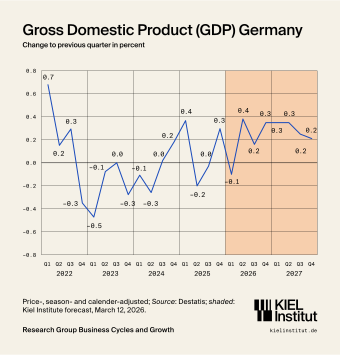
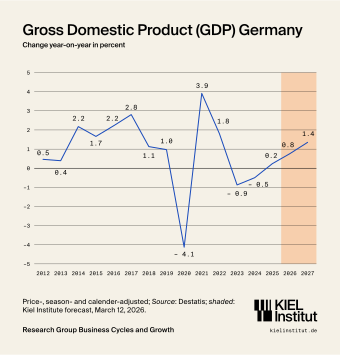
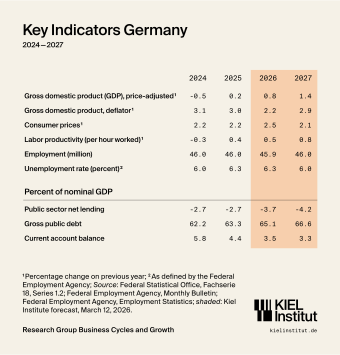
The German economy is gradually gaining momentum. However, the upward forces remain subdued and are temporarily dampened by the most recent spike in energy prices. According to Kiel Institute’s spring forecast, GDP is expected to grow by 0.8 percent this year and by 1.4 percent projected next year. Overall, the country has left the three-year recession behind and is now drifting into a moderate recovery, with expansionary fiscal policy providing the main impetus. Inflation is rising to 2.5 percent this year as a result of higher energy prices. However, core inflationary pressure will also remain well above the 2 percent mark throughout the entire forecast period.
The current geopolitical situation is fueling considerable uncertainty among companies. "The military conflict in Iran is threatening to create headwinds for the German economy," says Moritz Schularick, President of the Kiel Institute. It remains to be hoped that the spikes in oil and LNG prices —in line with market expectations— will last for a rather short period only.
In the scenario assumed for the forecast, the loss of German purchasing power due to a higher net import bill for crude oil, petroleum products, and natural gas amounts to 0.6 percent of annual gross domestic product. This will cause a noticeable dampening effect, but not a collapse of the economy.
Read economic forecasts now:
- German economy in spring 2026: Higher energy prices weigh on sluggish economic momentum
- World Economy in Spring 2026: Middle East conflict hampers economic activity
Even apart from the dampening effects of higher energy prices, the growth drivers remain subdued. "With the burden of significant structural problems, the German economy cannot currently make any major leaps forward," says Stefan Kooths, head of economic forecasting at the Kiel Institute. "Without the stimulus measures bought with high budget deficits, the momentum would be so moderate that it does not qualify for a self-sustaining recovery."
Moderate increase in exports, higher inflation
German exporters are likely to expand their business again, but this is not expected to provide much impetus to the economy. The Kiel Institute anticipates increases of 0.3 percent for the current year and 1.6 percent for the coming year. Given these moderate rates, the German export sector continues to lose global market share.
While economic output is currently only 0.5 percent higher than before the pandemic, private consumption has increased by almost three percent since then. The surge in energy prices is slowing private consumption expenditure, but it is still enough for an increase of 0.6 percent this year. Without the sharp rise in oil and gas prices as a result of the Iran war, energy prices would have dampened the inflation rate during the forecast period; now they are significantly increasing it this year. The inflation rate for the current year is now estimated at 2.5 percent (winter forecast: 1.8 percent), coming down to 2.1 percent next year.
Construction rebounds
After a heavy decline in previous years, construction expenditures are expected to increase noticeably again during the forecast period. The Kiel Institute anticipates an overall increase of 2.4 percent in both forecast years coming both from residential and non-residential construction. Despite strong increases in government purchases, spending for machinery and equipment will shrink by 0.3 percent this year and only turn positive next year, rising by 6.1 percent.
Turnaround in the labor market delayed, public debt rises
The moderate economic recovery stimulates the labor market with a delay only. A noticeable increase in the number of employed persons is not expected until next year, and even then, only because the unemployment reserve, which has grown by 500,000 people over the past three years, can still be drawn upon. In contrast, the aging population will cause the potential labor force to shrink during the full forecast period. The unemployment rate is expected to remain at 6.3 percent this year and fall to 6.0 percent next year. Since the upward movement in economic output is largely driven by fiscal stimulus, government deficits are swelling considerably. Relative to gross domestic product, the deficit is expected to rise from 2.7 percent in 2025 to 3.7 percent in 2026 and 4.2 percent in 2027.
Global Economy: Moderate growth
Assuming a swift normalization of oil and gas supplies from the Persian Gulf, the global economy should remain on its solid growth trajectory, supported by strong impulses for trade and investment from the AI-technology boom. Global output is expected to grow by slightly more than 3 percent both this year and next year. In Europe, the gradual economic recovery is expected to resume in the second half of this year, following a temporary slowdown due to higher energy prices.